
These songs make you watch all the credits.
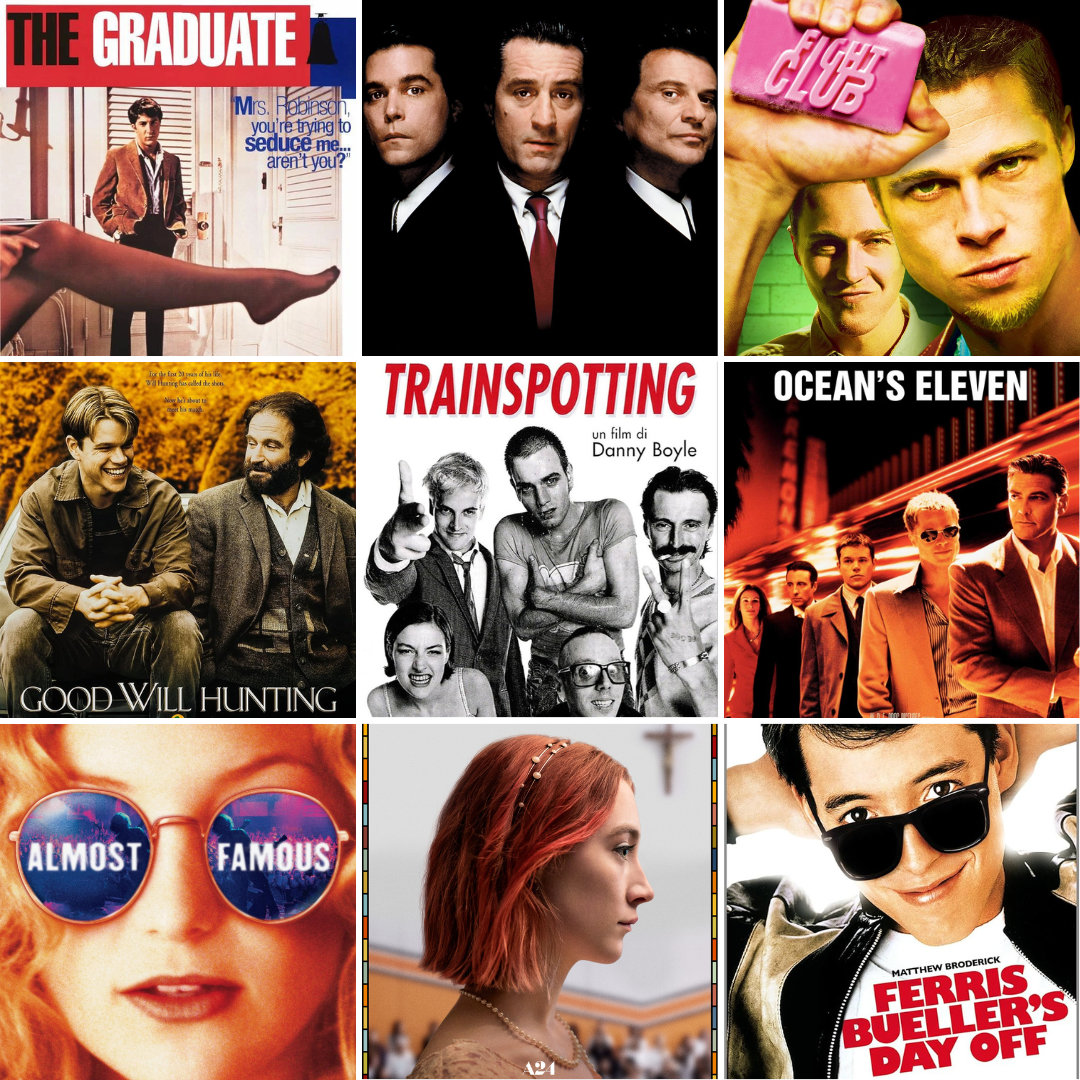
collage by Jake Harvey.
Movie endings carry a particular kind of power. Even when a movie’s story is messy or meandering, its final moments play an outsized role in your recollection of the film. This is done most effectively, in my opinion, when the perfect track is used to carry you from the final shot to the credits, crystalizing the emotions which linger after your viewing. In fact, this is a two-way street: just as a great song enhances a movie, a great use of song in a movie can enhance your appreciation of the song as well. In some special cases, the song and movie become fused together, almost inseparable from each other, creating iconic cultural moments. I have compiled this list of 7 movie outros and their song pairings with an eye for these sorts of moments. It is highly subjective and influenced by my taste in movies and music (and my sensibility for how they should be put together), so I could imagine a perfectly good list with entirely different entries. That being said, I contend that all of these moments have that iconic sense. Many of these soundtrack choices were accidental, unconventional, or quite lucky, but they all leave you with a feeling that you are not quite the same person as when you started. If you have not seen these movies, you should reconsider some things. Spoilers.
Honorable mentions
Lady Bird - “Hands In My Pocket” by Alanis Morissette
Ferris Bueller’s Day Off - “Oh Yeah” by Frankie Says
The Breakfast Club - “Don’t You Forget About Me” by Simple Minds
Donnie Darko - “Mad World” by Tears for Fears
The Graduate - “The Sound of Silence” by Simon & Garfunkel
Shower thoughts are rarely profound, but Mike Nichols had a great one. While making The Graduate, he had been listening to Simon & Garfunkel every morning in the shower, and one day it dawned on him that their music would be perfect for his film. This may not sound awe-inspiring, but using pop songs rather than orchestral arrangements was unusual for soundtracks in 1967. When Nichols brought “The Sound of Silence” to his editor that weekend, the two of them became convinced that they were onto something. As Nichols puts it, “It’s one of those miraculous moments you get when you’re making a movie. It’s better than sex.” The song opens the film as Benjamin glides blankly down a moving platform and closes the film as he and Elaine, in the back of a school bus, feel their adrenaline fade into uncertainty. In this famous moment, Nichols left the camera rolling well past the scripted moment of exuberance, so Hoffman and Ross’s fading smiles are perhaps genuine. The song, a masterpiece in itself, was written by Paul Simon about a close friend of Art Garfunkel losing his sight, inspiring the opening lyric “Hello Darkness, my old friend.” Benjamin’s old blankness returns as this lyric is sung in a vaguely nauseating moment that serves as one of the best movie endings ever.
Goodfellas - “My Way” by Frank Sinatra
Goodfellas ends not with Frank Sinatra’s timeless “My Way,” but with Sid Vicious’ obscure, punky version of the track. Surprisingly, Scorsese originally requested Sinatra’s recording, but Sinatra fittingly refused in order to distance himself from any renewed association with organized crime. When Paul Anka, who wrote the song, was asked about the use of Sid Vicious’ version, he admitted he did not know it existed, but approved immediately after hearing it. The choice makes far more sense than Sinatra’s version if you have seen the movie. After years living in paranoid luxury as he climbs the mafia ladder, Henry Hill is finally pushed by the FBI to betray his crew and spend the rest of his days in witness protection. Needless to say, he did not do it his way, and the song parodies his self-mythologizing. As Sid Vicious rages on past the final shot, the film runs through the outcomes of the real people that the movie portrays: deaths in prison, murders, and the collapse of Hill’s marriage. It is a sobering reminder that this all really happened, and as far back as any of us can remember, it is one of the greatest movie endings in history.
Fight Club - “Where Is My Mind?” by the Pixies
Few songs have become fused to movie outros as completely as the Pixies’ “Where is My Mind.” “You met me at a very strange time in my life,” says the Narrator to Marla right as the skyline of financial towers implodes in neat rows…and the guitar comes in. I have noticed stencil art of the Fight Club logo cropping up all over lower Manhattan recently, testament to the fact that since its 1999 release, Fight Club’s first rule continues to be widely broken. Though “Where is My Mind,” by its title alone, seems perfectly suited for this film, it was an eclectic choice by director David Fincher. The song, released in 1988, was a deep cut for the Pixies, who were highly influential but not particularly popular. The song itself comes from a moment of underwater disorientation when Black Francis was being harassed by a tiny fish during a scuba dive. This context casts the track’s half-dazed lyrics about swimming in the Caribbean in a more literal light. All of this makes the song a strangely natural fit for the movie’s final beat, where the Narrator’s unraveling sense of self meets the song’s fractured energy, punctuated by that distorted, blown-out guitar hitting right as the skyline gives way and Marla jolts in shock.
Good Will Hunting - “Miss Misery”by Elliot Smith
Like a lot of tweens, I declared Good Will Hunting my favorite movie roughly thirty seconds after seeing it. It had young Matt Damon, the Affleck brothers writing their way into the mainstream, and a Robin Williams performance that reliably opens the floodgates. But on rewatch, what stayed with me most was the moving soundtrack and the discovery of Elliott Smith hiding in the credits. Before this movie, Smith was beloved in the Portland indie scene, but largely unknown. Director Gus Van Sant stumbled upon him through a CD his friend gave him. He noted, “It reminded me of Simon & Garfunkel. Although, before I met Elliott, someone said, ‘Don’t mention Simon & Garfunkel to him.’” The irony here is irresistible, since Smith’s presence in Good Will Hunting mirrors Simon & Garfunkel’s in The Graduate so strongly. Most of Smith’s songs that appear in the film are from his incredible album Either/Or, which I highly recommend giving a listen. But “Miss Misery” was written for the film and appears in the iconic final montage in which Will finally quits his Harvard shenanigans and goes “to see about a girl.” Robin Williams famously improvised the final line of the film: “That son of a bitch, he stole my line.” When the film blew up, Smith was thrust abruptly into the spotlight: an Oscar nomination, a surreal two-minute performance in an ill-fitting white suit under blinding lights, and what he later described as “walking around on the moon for a day.” For millions, this was the moment they first heard his name, and that in itself makes this a worthy entry.
Trainspotting - “Born Slippy (Nuxx)” by Underworld
In the momentous final shot of Trainspotting, Mark Renton crosses a large, smog-covered bridge, delivering his final monologue about how he’s leaving behind his drug-ridden, criminal life and will now be “just like you,” all while he clutches his sack of stolen cash and smiles a bit too widely. Underworld’s “Born Slippy (Nuxx),” now an anthem of rave culture, was not a hit when Danny Boyle found it. It was a B-side that Karl Hyde wrote after a night of heavy drinking in Soho, London. Underworld initially balked at the proposition that this track, meant for half-legal warehouse raves, could become the “heartbeat of a film,” as Boyle later put it. But after seeing the footage, the duo was on board. The film’s soundtrack as a whole represents a significant innovation in soundtracking, expanding the vocabulary of music for cinema. After the movie came out, “Born Slippy (Nuxx)” exploded in popularity and helped push the UK electronic scene into a new era.
Ocean’s 11 - “Clair de Lune” by Claude Debussy
Ocean’s 11 is definitely the most questionable pick on this list, but I needed some classical music and I adore “Claire de Lune.” After two hours of sleek, fast-paced action, the movie slows down in its final moments as the characters reflect on the heist they pulled and, perhaps, the friends they made along the way. “Claire de Lune” floats in above the Bellagio fountains, rendered with striking beauty by director Steven Soderbergh as the whole crew stands in silence before peeling away one by one. It’s nice to see Las Vegas sentimentalized in a movie for once, and it is particularly charming in a movie that does not earn sentimentality whatsoever. “Claire de Lune,” written by Claude Debussy in 1890 and published in 1905, means ‘moonlight’ in French. Debussy once described it as an attempt at “the ultimate atmosphere of night and light,” and it is widely considered the quintessential piece of impressionist music. Set against the shimmer of fountains, it produces an unexpectedly tender farewell in a movie built on swagger.
Almost Famous - “Tangerine” by Led Zeppelin
In director Cameron Crowe’s words, Almost Famous “is a love letter to the power of loving music and what it is to be a fan.” Its narrative of a scruffy teen hired by Rolling Stone magazine to tour with and write pieces on rock bands of the early 70s is highly autobiographical of Crowe’s life. Given Crowe’s love of music and the plot of the movie, the soundtrack is chock-full of great rock tracks. This soundtrack would have had astronomical licensing costs, but Crowe was able to finagle deals by leaning on his personal relationships with rockstars and appeals to the artists’ own nostalgia for the glory days of rock. Of all these artists, Led Zeppelin required the most haranguing. Crowe and music supervisor Danny Bramson actually flew to London to screen a rough cut for Robert Plant and Jimmy Page, who were famously protective of their catalog. Moved by the film, and perhaps by Crowe’s glowing portrayal of them in an old Rolling Stone piece, they agreed to license several songs, including “Tangerine,” a rare gesture for a band long considered the “holy grail” of film music supervision. Apart from an enthralling Philip Seymour Hoffman performance, this is not my favorite movie on the list. But its affection for the music world and the fact that it revolves around a music magazine makes it too fitting to ignore. And since “Tangerine” is my favorite Led Zeppelin song, I had no real choice.
edited by Arjun Bhakoo.
collage by Jake Harvey.
movie posters believed to be the property of the film’s distributor, studio, or original artist.