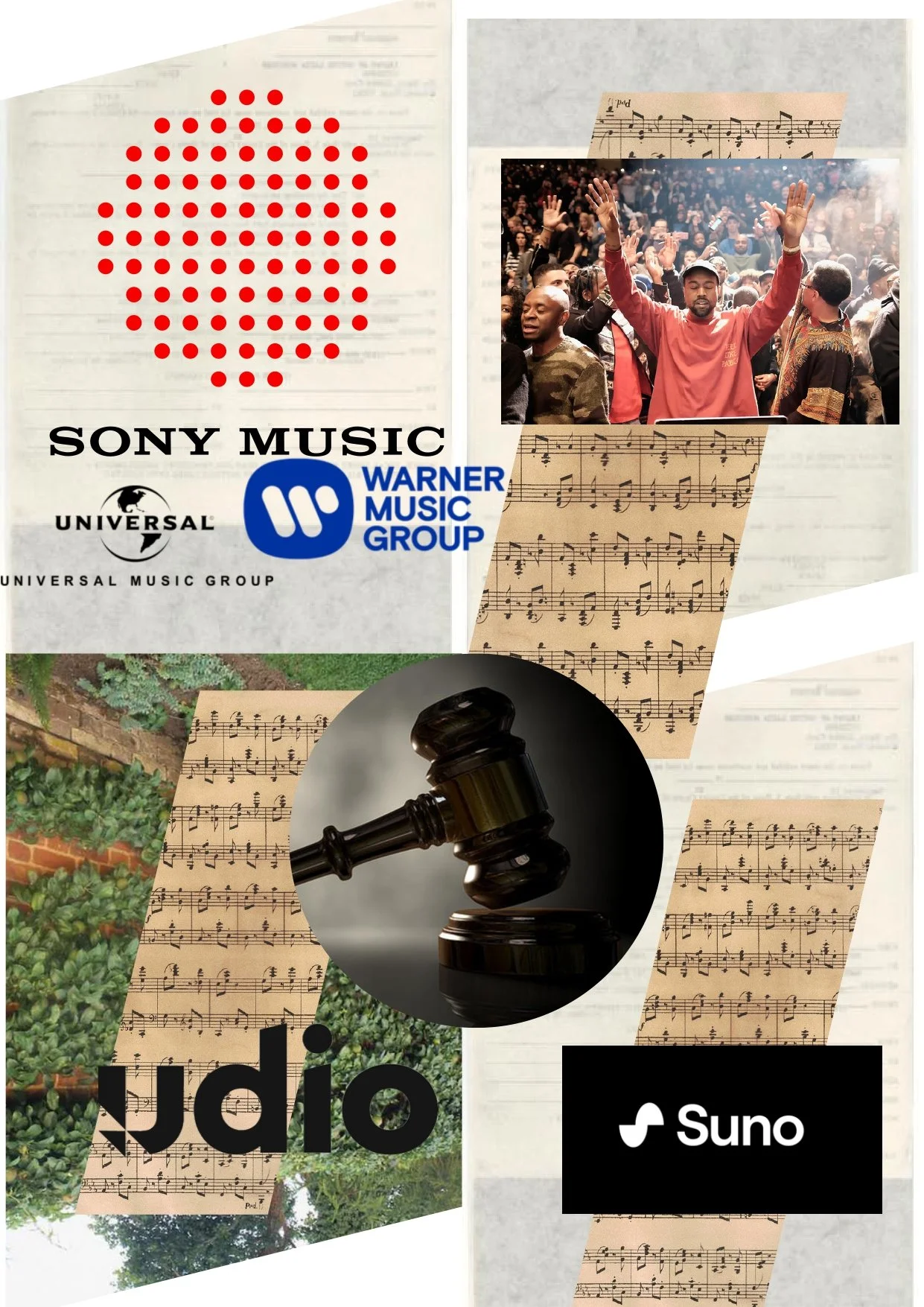
Modern music has always walked the tightrope between fair use and infringement. In this article, I discuss the power dynamics of music copyright through examples involving major artists like Kanye West and the major record labels. I also examine the advent of AI in music and how the industry is scrambling to secure its future. Looking ahead, who will be protected, and who will be left behind?
art by Alexandra Moxey
Music is catnip for humans, and everyone wants a bite: artists, labels, publishers, songwriters, producers; the list goes on. The digital approach of the music industry (Spotify, TikTok, Apple Music) has allowed greater connectivity between artists and their audiences. Music is being consumed more immediately and with a wider reach than ever before. Copyright protections come from Article I, Section 8, Clause 8 of the U.S. Constitution, which allows Congress to protect artists' work so they can profit from their creations and control how their work is reproduced. Fair use is the exception that allows limited use of a work without permission from the artist who created it. It is up to courts to decide what constitutes fair use on a case-by-case basis by using 4 factors: how the work was used, how much was taken, whether it damages the market value of the original, and the work's effect on the market. Music has always depended on artists borrowing from one another. In genres like rap and EDM, sampling has always been part of how music is made, and the line between copyright infringement and fair use has been blurry, with dozens of celebrity artist cases each year. There is even a saying in the music industry, “If you write a hit, expect a writ.” AI has blurred the music industry’s already blurry copyright line. The systems can literally absorb an artist’s entire collection of works and give nothing in return, and begs the question: who owns a sound once its origins can no longer be traced? The hot topic now is whether the law and the music industry can change to ensure artist protections.
Copyright and Fair Use systems are meant to protect artists from having their creations used without giving them credit or compensation. The reality is that the system is far from perfect and has not protected all artists' work equally. For many small, up-and-coming artists, it often isn’t worth it to go through the legal process if someone illegally uses their sample due to the high cost of lawsuits and legal counsel. This is confounded by the fact that revenue earned from their music may not exceed the costs of legal services. The use of smaller artists’ music without credit devalues their work and oftentimes impedes the trajectory of their careers. In many copyright cases, it rewards the party with the best lawyers and most resources, allowing larger artists to benefit off the backs of smaller ones. The four factors of fair use can result in inconsistent outcomes that favor those artists who can afford counsel.
Kanye West’s track record demonstrates this dynamic poignantly. West has a well-documented pattern of using the music of smaller artists, failing to credit them, and then facing lawsuits later. Through this strategy, he takes a calculated bet that most of the artists he exploits lack the means to pursue him in court. And for the ones that choose to go to court, a settlement would be less costly for him than a trial.
Most recently, a Los Angeles Jury found West personally liable for copyright infringement and ordered him and his business entities to pay $438,558 in damages on May 12, 2025. The lawsuit was filed by Artist Revenue Advocates (ARA). They alleged that the songs ‘Hurricane’ and ‘Moon’ infringed a composition titled MSD PT2. The sample was created by Khalil Abdul-Rahman, Sam Barsh, Dan Seeff, and Josh Mease. The final version of ‘Hurricane’ did not contain the sample, but the plaintiffs argued that an earlier version of the track did. It was played during Kanye’s first listening party at Atlanta’s Mercedes-Benz Stadium on July 22, 2021, with 40,000 fans in attendance. Kanye’s attorneys called this instance a shakedown, but given his history of dozens of copyright infringement lawsuits, it's hardly a shakedown and more an unlikely instance of small artists standing up for their rights. Throughout the proceedings, the ARA attorney argued that West used the sample, monetized it at a high-profile event, and discarded it. MSD PT2 will be permanently associated with West, and it is unlikely that other artists will pick it up. The ARA is preparing to appeal and seek larger damages.
While the outcome of this case was an important win for smaller artists, this group had the privilege of being aided by the non-profit advocacy group the Artist Rights Alliance. For most small artists whose work is used without credit, winning a legal case against a celebrity artist is still impossible.
Generative AI music platforms have shaken up the music industry and left the legal system scrambling to catch up. Platforms Udio and Suno rolled out their models in late 2023 and can generate surprisingly human-quality sounding music almost immediately after receiving a prompt. These systems are trained on libraries of pre-existing music.
In June 2024, the three major record labels Universal Music Group, Sony Music Group, and Warner Music Group filed lawsuits against Udio and Suno. They alleged copyright infringement, claiming that the AI models had been trained on copyrighted recordings without permission. They also demonstrated how AI could generate outputs that are similar to copyrighted material. During the proceedings, labels prompted an AI platform to create a song similar to ‘My Girl’ by the Temptations, and the AI spat out a track with a strikingly similar melody, chords, and backing vocals.
In August 2024, Udio’s legal documents showed that the platform had used copyrighted works to train its models using audio from YouTube, which was significant to the case because YouTube has technological measures meant to control access to its content, preventing users from scrubbing audio off the platform. Udio argued that taking this music off of YouTube constituted fair use because the training process and output were sufficiently transformative that it could not be considered infringement.
The major labels also argued that, under the fourth fair use factor, AI-generated music could harm the recording market. This argument struck a chord with me as a reader because it seems painfully obvious that if listeners can create an unlimited library of songs that sound like their favorite artist, this poses a threat to the market for original music.
Another separate complaint was raised by Sony under the Digital Millennium Copyright Act. In October 2024, Sony amended its complaint, alleging that Udio had trained its model on copyrighted material and had also circumvented the technological process YouTube uses to prevent content from being removed from the platform. Udio proposed a motion to dismiss the claim, and Judge Alvin K. Hellerstein rejected the motion. The judge declined to rule and said that Sony must present a fuller factual record. The lawsuit remains ongoing, awaiting a ruling that will be precedent setting on whether training AI on unlicensed music counts as fair use, expected as early as this month.
Both Universal and Warner Music Groups reached settlements with Udio, different from Sony’s litigation based approach. I believe these settlements are indicative of where the future of music is headed and of the major labels' recognition of the importance of getting ahead of AI’s advent into the music industry. They also have the funds to secure their futures and to maintain their hold on 70-80% of the recorded music market. The structure of the agreements of powerful music companies shows who has secured their future in this new landscape.
Under the settlements’ terms, Udio agreed to a blanket licensing model in which the platform pays a fee to use all recordings owned by the labels, and the model would be trained only on licensed music. Warner reached an agreement with Suno under which artists and songwriters can opt into adding their image likeness and voices to the licensed database used to produce AI-generated songs. By settling, the majors are securing their oligopoly, converting the AI threat into a stream of revenue they control. They can generate revenue from blanket licensing deals and decide how their artists' music appears on these platforms.
Since these agreements have been made, the CEO of Udio, Andrew Sanchez, has adopted what he calls a “walled garden approach.” This means that users can create music in the style of artists whose music is licensed on the platform, but they cannot take the music off of Udio, which prevents reproduction. Sanchez argued during his May 19 talk at Oxford that the “walled garden” is ethical and that the platform cares about artists' and labels' rights. He positioned Udio as the ethical music AI software, throwing Suno under the bus as an opponent not on the same moral level.
The “walled garden” concept was shocking to me. Did the music industry not learn anything from its battles with digital piracy over the last two decades? There are immediate practical concerns regarding this vision. What enforcement mechanism will be robust enough to prevent people from removing AI-generated music from the platform? Historically, the music industry struggled to control peer-to-peer file-sharing networks in the 2000s, as millions of internet users downloaded copyrighted music without compensating artists. Sanchez left the door open for music to leave the platform in the future, saying the thesis might hold down the line, assuming parties are comfortable with it. I wonder how hard Udio will try to keep AI-created music on its platform if its goal is for it to spread off the platform. To me, it is blatantly unclear how this “walled garden” will work due to music’s habit of jumping fences.
I am also skeptical of the ethical framing that Udio adopted after its settlements, given the discrepancy with how the platform operated prior to that. Udio’s platform was built on copyright infringement. The model was trained on music scraped from YouTube. Udio only sought licenses after it was sued by the three largest record labels in the world, which threatened its very existence. In this sense, Udio takes a similar approach to an artist who profits off the backs of emerging artists, like Kanye West, with the ‘use now, pay later’ tactic. What is particularly dangerous about this in Udio’s case is the scale at which it used unlicensed music. The “walled garden” approach is a way to paper over how Udio stays in business under the guise of an ethical approach. Overall, the settlements with the majors protect the labels and the artists whose music they control. Independent artists and songwriters whose recordings were part of the AI training data likely don't have the resources to fight back. The majors certainly know how to protect their own interests and did so in the face of AI. I am interested in seeing how, and whether, the framework of this settlement will help independent artists unaffiliated with a major label.
These settlements provide some clarity on how AI will interact with the music business in the future, but they leave us with more questions than answers. The question of revenue allocation is still up in the air. If an AI creates a song that is made from the work of various artists, how will they be credited? How will the percentage of revenue they collect on each song be divided up? Traditionally, when it comes to samples, producers use a piece of a song; a negotiation over the price of the copyright ensues, and then royalties follow. When an AI is trained, influences are blended, maybe to the point that attribution to a specific artist becomes impossible. Whether the business will move toward a blanket license model or toward software that can determine the percentage each artist contributed to an AI-generated work remains to be determined. It is important to note that it is not in AI companies' best interests to track which artists are owed what percentage of royalties, as this could bind them to paying them. Another question is, who is the creator of music that AI creates? Is it the user, software developers, or the artists? And how will this be determined? Are AI systems going to be recognized as authors in the future? Not to beat a dead horse, but the ‘walled garden’ idea and its enforcement are worth mentioning as well. Any anti-circumvention measures are likely outdated and ill-equipped to address the advent of AI. Whether Udio will be able to stop users from spreading AI-generated music and hopping the garden fence remains uncertain. Lastly, artists who aren’t part of the major-label system aren't afforded many protections when it comes to AI music platforms. Emerging artists have always struggled to defend their work; AI worsens the problem. If you are a small songwriter whose song was scrubbed off of YouTube and inputted into Udio, you have no blanket license or deal with an AI company to protect your revenue. What happens to those artists? What Kanye has done with individual samples, AI companies can now do with entire catalogs.
The advent of AI has thrown the music industry into a frenzy. When it comes to music and copyright, the system has favored the wealthy. AI entering the music scene magnifies this injustice. Settlements between the major labels, Udio, and Suno represent an important step in which the platforms pay licensing fees, and artists consent to the use of their work. This progress, however, has been secured by the industry's most powerful players for themselves and their massive labels. Millions of smaller, independent artists’ works have shaped these AI systems, yet they have not been compensated. Looking ahead, Congress and the music industry will try to figure out how to prevent smaller, independent artists from being taken advantage of by AI companies. They have a duty to apply the same principles of recompense according to Intellectual Property law that are afforded to the major labels. If independent artists believe AI can outpace their work, and they cannot afford to protect what they make, some may stop creating. The result is a music scene that becomes less diverse, less unique, and less creative. What happens next will influence the way artists create and whether their labor is fairly valued. As laws and infrastructures take time to catch up with the advent of AI, it continues to break into the mainstream. As an avid music listener, I hope this happens ethically and in a regulated manner. It is and will remain important to me as a consumer to know where and by whom the music I listen to was created. Artists and people deserve to benefit from what they make and feel secure in the fact that their work will remain their own. Copyright law, for all of its imperfections, exists to enforce the idea that creation has value, and this has never been more important than in our current moment.
Sources:
https://www.culawreview.org/journal/copyright-law-fair-use-vs-the-exploitation-of-emerging-artists
https://hulr.org/fall-2024/defining-authorship-for-the-copyright-of-ai-generated-music
https://ulrfsu.org/2025/04/09/copyright-laws-blurred-lines-in-music/
https://sports-entertainment.brooklaw.edu/music/music-copyright-in-the-gen-ai-age-where-are-we-now/
edited by Alyssa Manthi.
art by Alexandra Moxey.