“I had an F-minus, but that’s behind us.”
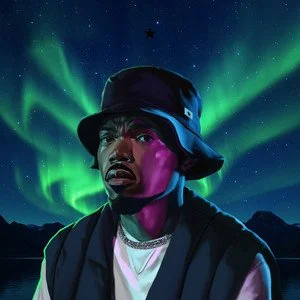
If his own lyrics are any indication, even Chance the Rapper knows 2019's The Big Day was a massive step backwards. As an album marketed and focused on his (now-defunct) marriage to Kirsten Corley, Chance's official debut was so universally panned (well, almost universally, if you ask Firebird's Marley Pileggi), that people started talking about Chance's career in the past tense. Who among us on hip-hop twitter didn't laugh at that video impersonating Chance squealing “Ooh I love my wife, I love my wife, AGH!!” (I laughed again as I hyperlinked it.)
But, after six long years of derision, STAR LINE is a return to form. Chance comes out swinging on "Star Side Intro" with plenty of quotables that tell us his confidence never wavered: “I got a SIG Sauer called MC Hammer/I got a chain on called ‘You Can’t Touch This’” and “I left breadcrumbs when I read my rhymes/So if I catch a red dot to the dome/They'll find me with a note on my head saying, ‘You read my mind.’” And the real ethos of the entire project, “Celebrity barber, but my stars all lined up/The three went platinum, the one went diamond/I had an F-minus, but that's behind us,” shows a self-assured Chance who knows his last project was a dud. STAR LINE asks the question: so what?
The vocal line between the verses of "Star Side Intro" repeats "working for Star Line," a nod to the Black Star Line, Marcus Garvey's back-to-Africa shipping line way back when. Garvey’s basic idea was if the Black community could entirely own something, then it'd both create communal pride and remove dependency on white people. You have to progress economically before you do socially or politically. Completely owned, operated, and financed by people of African descent, Garvey’s plans were rooted in Black liberation, a theme Chance tackles through the project. Taking inspiration from Garvey, who earned the nickname “Black Moses,” also highlights the religious undertones of many of the album’s songs. STAR LINE is unapologetically Black. Chance tackles the legalization of weed, the Black church, medical racism, and street politics. Slightly heavier content than loving his wife, wouldn't you say? It's not that Chance’s saying anything we haven't heard before, but the breadth and depth of his commentary is surprising. These heavier elements are balanced by Chance’s naturally high-pitched cadence, so he gets away with never sounding too preachy either.
"No More Old Men” is one of these heavier tracks, where Chance tackles the lack of mentorship young Black men tend to face. The premise is well-trodded: when the old men in our lives pass, who mentors the new youth? As long as our communities stay this dangerous, the cycle accelerates every generation with increasingly fewer role models to provide guidance. With that in mind, Chance’s references to older men both in his personal life and in pop culture are well-received: Mr. Harper and Mr. Darden in the first verse gives way to Luther Vandross, Randy Moss, and Floyd Mayweather in the second. Chance got exposed to these celebrities through his father and uncles, his mentors. Without these old men, “the kids don’t even have a chance no more,” which you can either read as self-deprecating, as if Chance himself fell off, or a flex, as if no one else has taken his crown yet. Either way, it’s a slick turn of phrase. The harsh reality of this line—“I used to play Street Fighter with my play cousin/Now the streets'll have you playin' with your real cousin”—also prompted a stank face from me.
Filling the mentorship void, Chance touches on what he coined the four Black commandments:
One: Watch yo’ health, that's yo’ wealth
Two: Watch yo’ brother, that's yo’ self
Three: Watch yo’ home, that's yo’ door
Four: If they want it, we go to war.
Framed as “Knowledge that could help a young man go forth/'Fore the day you don't see these old men no more,” these survival guidelines reveal the “catch-22” between wanting your community to thrive and needing to survive day-to-day until it does.
"The Negro Problem" doubles down on grizzly vignettes of inner city life, with each verse tackling two classic ‘Negro problems’: our experiences with both the judicial and medical systems. These communities are often over-policed, yet so many families don't get justice as criminals roam free. Chance claims:
It's a lot of complaints but we just can't file 'em
Open case, shut case, still won't solve 'em
The judge said ‘What? I don't see no problem’
The world said, ‘Yup, that's the Negro Problem'
You get neither the security of a safe neighborhood nor the security of expecting the police to help. The second verse is based on the idea that Black people (especially women) get screwed in doctor's offices, not to mention medical bills that bankrupt those without insurance. The uninsured (which is of course correlated with class, which is of course correlated with race) usually go to the doctor only when necessary, making it more likely that issues that previously went undetected are now too far gone without massive intervention. My favorite bar on this track says it better:
If I'm billable and gullible enough to go
Might as well show up in a tux, you know
Make sure my hearse and ducks in rows
'Cause that bill's gonna rupture your bucks, you know
Chance speaks to the black community’s apprehension to modern medicine, likely ingrained from its controversial history. (Black people could probably still stand to go to the doctor more often, though.)
Chance turns inward a lot on STAR LINE as well, most admirably on “Back To The Go,” easily my most played track from this album. Back to square one, Chance dubs himself a “homeless hometown hero,” a nod to not only how much he's put Chicago front and center over the course of his career, but also how he lost his “home” in the wake of divorce. He's “back at the bachelor pad, chicken scratch on the pad,” and you realize it would've been impossible for Chance circa 2019 to pen these raps. Over minimalist loops and chipmunk samples that scream ‘Kanye disciple,’ Chance recognizes his setbacks and shortcomings not as permanent conditions but as means to rise even higher: "You bound to see tears if you ball enough/They say the harder you fall if tall enough, and I fall." He also delivers a hook I can't stop singing in the same hopeful spirit:
I fall on my face sometimes
I look at myself, I cry sometimes
I need a little space myself
I pick myself up, I'm right sometimes
Tell Mama I'm back in my room
I'll be packing up soon, I just need to lay low
Anyone ask if you see me, say ‘No’
Been round the board, now I'm back to the ‘Go’
But it isn't all sunshine and rainbows with this album. Featured artists generally fall into one of two camps on STAR LINE. Most of the supporting vocalists fit like gloves: BJ the Chicago Kid ("The Negro Problem"), Cleo Sol ("Star Side Intro"), and Jazmine Sullivan ("Speed Of Love") elevate their respective tracks with soulful contributions that mesh perfectly as interludes to Chance's raps. Special shoutout to the serenity of Jamila Woods’ “On and on and on and on, I know it goes” chorus on “No More Old Men” that declares we'll live "til our hair turn white," which is especially powerful given Chance's message on the track. The featured rappers, however, are less consistent. Smino and Lil Wayne are fine enough on “Tree,” and TiaCorine and Vic Mensa have pretty good showings if you've never heard a Playboi Carti or J. Cole verse respectively. (When Mensa came in on “Back To The Go” I gasped thinking it was Cole for a few seconds. As soon as he changes cadence about eight bars in, Mensa sounds like himself, but I still felt baited.) Young Thug showed up for a quick check on “Gun In Yo Purse” and couldn't bother to stay on topic for more than a stanza. Other than Joey Bada$$ snapping on the 2022 loosie "The Highs & The Lows," the rap features let Chance down here, and with more consistent guests, STAR LINE could've been that much better.
Chance himself couldn't completely put down his Green Goblin mask of unseriousness. (In small doses, it remains part of his discography’s quirked-up charm, but it got dialed to the highest setting on The Big Day.) Sure, there's nothing as egregious as “Hot Shower” here, but “Space & Time,” “Link Me In The Future,” and “Pretty” show us that he's not out of the woods yet. The same singing style that plays endearing on "Tree" is grating on “Future,” and it only frustrates me because Chance gets so many incredible singers on this project yet still sings too much himself. “Pretty” has thoughtful ruminations on love, but lines like “The mirror's got a crush and I get a rush when I see my face” and “My mom told me l'm a nice person/I got left but maybe I ain't find the right person” are far clumsier than most of Chance's other material here.
As someone who grew up in the church, everything incredible about STAR LINE shows up in spades on “Letters” with Rachel Robinson, its verses organized as letters to the church. The church remains a pillar of many Black communities across the country, mine included. Chance takes aim at churches who take advantage of their communities (“Branded Bibles, sell it for double...First Lady’s walking around with furs and titles”) while not stepping up when those same communities need them (“Withhold shelter from niggas for survival...But when it's really on your dogma, it's Silent Bob/You just take them government checks and smile and nod.”) Chance invokes Dr. King, Malcolm X, and Aretha Franklin as figures who either made their name in the church or grew up in it, and keeps the pressure on as his delivery gets more emphatic throughout each verse: “Don't lay down now when you know we at war/Don't lay down now when there’s fire at your door/Don't lay down now when you know they should feel a noose.” In Chance’s eyes, the church is failing us. In the final letter—this one to the global Church (called the ‘Body of Christ’ throughout the New Testament)—Chance offers this striking visual: "I write to you with tattooed tears and heavy shoulders/An angel with a hand on his hip, the gun holstered.” This is likely a reference to Jacob’s wrestling an angel in Genesis—a reference which also asks the Church to stand up for itself, a la David and Goliath. In a nod to the fact that our tent is to be impossibly wide for all, he pleads: “Dear Body, protect the body/‘Who's all coming?’/‘Just everybody.’” “Letters” is home to STAR LINE's best rapping performance with respect to both technique and content, with wonderfully soulful instrumentation and vocals to boot.
STAR LINE is a hopeful album. Despite the heavy material throughout much of the runtime, Chance always ends each song with positive energy, or at least seeks it. The ending of “The Negro Problem” (“My problem is your problem/Your problem is my problem”) grounds us in community building; “The Highs & The Lows” looks head-on at the natural ups and downs of life (“[When] you feel like your back's on the ropes/Gotta take the highs with the lows”); and despite white people profiting from weed while Black people stay in prison for getting caught with it, “Tree” playfully reminds us that “Though life will have its issues there will never be/A problem with the weed.” STAR LINE brilliantly balances brutally honest critiques with these dreamy, self-assured moments and the total package is commendable.
In interviews during STAR LINE’s rollout, Chance was candid about this hope, and how he hopes to move on from the speedbump that was The Big Day and no longer dwell on the past. It would’ve been super easy to lash out at haters this entire project, maybe even drop his own Kamikaze, Eminem’s response to Revival’s awful reception. Thank God he didn’t. “The most important thing that Chance The Rapper could be putting his pen to is not always necessarily proving the haters wrong,” he told XXL. “What I did with my project is I made a lot of people who loved me happy and put out a project that they could live with for a long time.”
And we back.
edited by Arjun Bhakoo.
album artwork believed to belong to either the publisher of the work or the artist.