The anatomy of “coworker rap”: an investigation into a baffling subgenre.
For those who would rather throw tomatoes than applaud, a whole new world of hip-hop awaits.

art by Kevin McDermott.
As you open Instagram Reels, the instrumental to Mobb Deep’s classic “Quiet Storm” starts to trickle through your phone speaker. In typical short-form fashion, your screen is split half-and-half between a commentator and a music video. Enter rapper Dax, who is elaborately costumed as a copyright-free rendition of a Predator alien (for some reason). He raps for about two seconds—then, a booming, echoing fart noise plays as reactor Maccdanny pauses the video just to laugh, with no further commentary. The video racks up almost 2 million views and over 200,000 likes, and there are countless more like it. Welcome to hip-hop’s digital mainstream in 2026.
In the wake of the genre’s recession from the top 40, budding and established hip-hop artists alike are struggling to drum up mass attention for their releases. Dax positions himself at the forefront of a movement centered around outrageous soundbites and visual antics, essentially “rage-baiting” viewers. Those who employ this strategy are often referred to mockingly as “coworker music” or even “burger rap” (coined by Maccdanny himself).
Initially, the term “coworker music” was informed by a certain public palatability necessitated by the workplace aux, hence its association with bread-and-butter bands like AJR and Nickleback. But the phrase has migrated from the sales floor to the breakroom, where most everyone has had to make musical small talk with a fellow employee they found a little strange; a phenomenon corroborated by media representations of the “weird coworker” stereotype, à la Dwight Schrute from The Office. This etymological shift towards the private life of the disturbed laborer encompasses artists like KILL KARL, whose excessively profane song “I’M A METALHEAD, BITCH!” sports a clear intention of being indigestible—almost the exact opposite evocation for which the denomination was originally created.
Extrinsic to the marketing mission, rappers in this circuit also bear quite a few sonic similarities, implying some sort of correlative artistic tendency. Production-wise, many of these artists seem to have stagnated in a meta of 2018-esque trap beats, decorating them with rapid-fire aggression and eye-roll-inducing punchlines. They also make a point of paying no mind to the commodity of “swag” exuberated by their more culturally-lauded foils like Future or even Lil Pump—the latter of whom is a constant subject of ridicule for them, even today in his fading relevance. These traits could be offshoots of late-2010s “YouTube Rap,” which, by virtue of its medium, emphasized fabricated drama and lyrical gymnastics over the passionate expressions of worldview and struggle found in traditional hip-hop.
Both movements share a common ancestor in the form of the original rap pariah himself: Eminem. The proverbial eviscerator of “mumble-rap” has since shifted his attention elsewhere, focusing instead on chastising those who dare try to do the same. On "Unaccommodating," he raps, “The more they study my music, the more they remind me of eyeballs/I’m watching my pupils get cornier [cornea].” A light jab that at least induces a heftier “har-har” than the lines of his pale imitators, but the lineage is clear. He even admits it himself on his recent track “Bad One”: “This whole subgenre with all these corny white rappers, I’m not a fan of it/It ain’t my fault, but like sock puppets, I had a hand in it.” Eminem’s dad-joke punchlines be damned, it’s doubtful that he would be too happy about Dax’s desecration of a Mobb Deep beat.
The imitative, outlandish nature of its songs brings the authenticity of coworker rap into question. It’s a matter of the chicken and the egg: Is Dax’s donning of a bald cap and Gandhi-like robe as he levitates in the lotus position the truest form of his creative expression? Or is it simply to get a laugh out of Maccdanny, egged on by passive scrollers? He did not respond to Firebird’s request for comment, but one of his algorithmically-adjacent peers did.
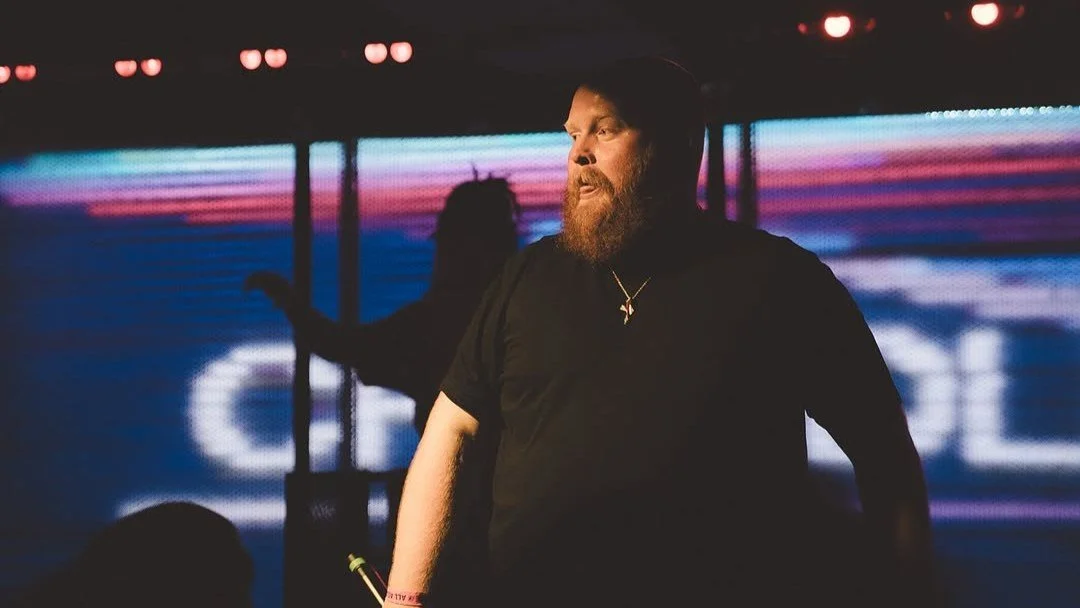
photo of Chandler Matkins taken by Hillary Safadi.
Chandler Matkins, AKA Chandler, is a rapper from Richmond, VA who rose to notoriety following a similarly controversial (albeit thankfully more minimalistic) clip in which he raps “I’m running all over the place, blue in the face, looking like Sonic” over a suitably playful, bouncy beat. The 8,000+ comments on the Reel range from Kendrick Lamar comparisons to straight-up death threats.
Considering his silly videos, mercurial vocal delivery, and shoehorned pop-culture punchlines, it tracks that Chandler has been the target of Maccdanny a time or two. But what insight does he have to offer into the mind and intentions of a “coworker rapper?” Rather surprisingly, he doesn’t take too harshly to the label.
Chandler admitted that “There was a point in time where [he] wrote to get the goat,” a characteristically Southern way of saying that he once aimed to get a rise out of viewers in the hopes that they would come back for more. “I’ve outgrown that now,” he says, having made peace with his listener relationships over the course of his half-decade musical career.
“I have people that love my work and people that despise my work. I have faced them both online and in person. Every end of the spectrum. To say that it wasn’t taxing in the beginning of notoriety would be ridiculous. It was. Now, I’ve come to enjoy the ride.” His outlook—matched by his friendly disposition—is decidedly optimistic. “If ‘coworkers’ are the ones listening, then so be it. I appreciate them. [...] They’re talking about what I’m doing. That’s good enough for me.”
Still, he’s not particularly a fan of the Maccdanny style of reaction videos, which may draw the wrong kinds of onlookers to his channels. “If you have a genuine critique that you can stand behind and fight for, more power to you. If you’re dropping fart sounds over my music and saying nothing of merit, that’s also fine, but like…no, I don’t have respect for that sub-genre of ‘react’ videos.”
Chandler’s testimony is a refreshing reassurance that at least some of these guerilla marketers-slash-bar spitters aren't just in it for a quick buck. But it appears that “coworker” clownery spares no one, artistic integrity notwithstanding. The joke, then, is that the forms of content typically inhabited by coworker music are dangerously conducive to uninspired parody, and hence, bad-faith listening.
edited by Alexander Malm.
art by Kevin McDermott.