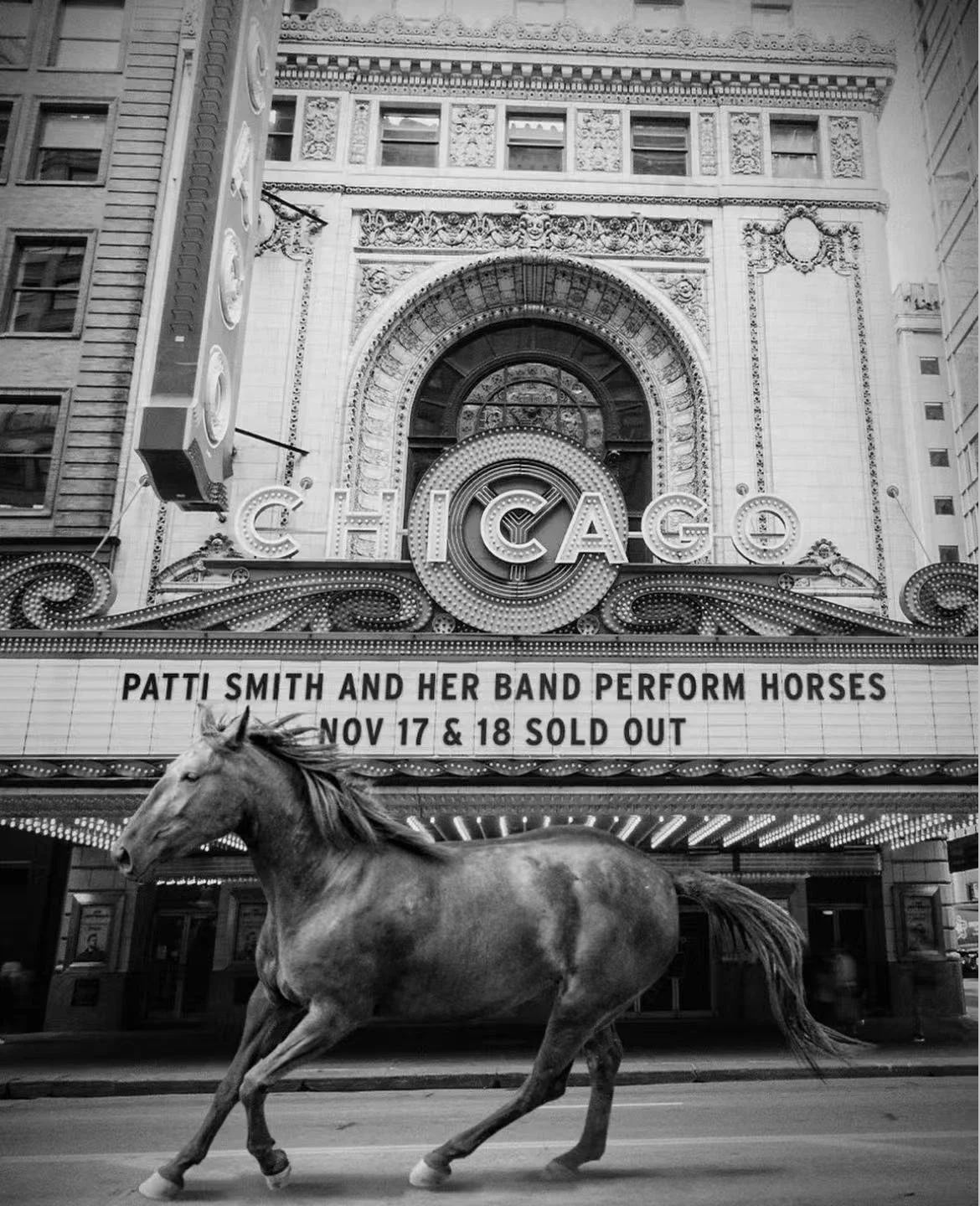
Patti Smith in Chicago Theatre.
Fifty years after her historic album Horses, Patti Smith returned to her birthplace, Chicago, with a performance still burning with unmistakable power.
In the New York of the 1970s, art seemed to live beside poverty, danger, and a restless kind of hope. Punk was just beginning to take shape, still raw and unnamed. It was a scene ruled almost entirely by men, a world full of misogyny. Women were usually treated as decoration—muses or ornaments in some male artist’s story. Patti Smith stepped into that world boldly. She pushed for de-gendering long before the word became common. The suit she wears on the cover of Horses, and her unapologetic display of unshaven armpit hair on the cover of Easter, were both declarations of women’s right to inhabit their bodies as freely as men. Onstage, she was rough-edged and direct. She sang about the things people weren’t supposed to say aloud; she walked straight into the forbidden as if it were simply the truth she felt compelled to tell.
Jesus died for somebody's sins, but not mine
Melting in a pot of thieves, wild card up my sleeve
Thick, heart of stone, my sins, my own
They belong to me, me
People said, "Beware", but I don't care
Their words are just rules and regulations to me, me
The lyrics of “Gloria” were nothing short of radical, startling in their boldness, almost shockingly ahead of their time. That fierce, uncompromising presence turned her into a symbol of female rebellion for an entire generation.
This year marks the 50th anniversary of Horses, her 1975 debut album. On November 17th and 18th, she played two shows in Chicago. As an icon who has shaped half a century of music and imagination, her return drew crowds to the Chicago Theatre. I was one of the thousands waiting to see her step into the light—someone for whom she has been one of the deepest influences.
She walked onto the stage in her signature black suit, just as she did on the cover of Horses, though her once-fluffy black hair had become long and white. Most of the audience was in their fifties or sixties, many older still. They called out “Thank you!” and “Patti, we love you!”. I sat in my seat feeling as if I were dreaming. I sat in the audience, feeling as if I were dreaming. The elder lady sitting next to me, with her silver hair, was completely swept up in the music, her voice trembling with emotion more than once. As a member of the younger generation, I didn't experience their era, but over the years, I've glimpsed that world of punk, rebellion, and the freedom of the soul, through her words, poetry, and songs. Patti has never been a relic sealed away in the 70s and 80s. She is not nostalgia. She is history that kept walking.
The show ran for about two hours. Midway through, Patti stepped offstage for a moment and the band took over, performing Television's "See No Evil," "Friction," and "Marquee Moon". This scene is significant for anyone familiar with the history of New York's underground music scene in the mid-1970s. It was the era when Smith and Television performed side-by-side in CBGB club, while the Ramones and Talking Heads grew up on the same stage. This interlude is like a tribute, opening a door to memories of Television and that raw yet glorious era.
The most striking part of the night was that, aside from those few songs during the intermission, Patti maintained astonishing energy and an exceptionally high level of vocal performance for most of the night. She moved with the music, lifting her arms, tossing her white hair. At moments, the entire theater seemed to breathe with her. Her vitality felt impossible for someone already 78-year-old, but at the same time, exactly like what you’d expect from her.
Later, she shared the story behind “Because the Night”. It is a memory about waiting and love. When she was young and in a long-distance relationship, she’d sit by the phone, waiting for her boyfriend’s call from another city. When she spoke about those old moments, there was a warmth in her voice, as if she were lifting the beauty of those years back into her hands. This tenderness didn’t dull her sharpness; instead, it revealed that her rebellion had never been rooted in anger, but in a power born of sustained love and a continued willingness to feel the world. She’s an active user on Instagram, and if you follow her, you’ll notice—she posts these small glimpses of her life: snapshots, bits of poems, little diary-like thoughts, even the K-pop she’s been into and the comics she read, maintaining a simple yet passionate curiosity about the world. While she was speaking, I caught myself wondering whether I’ll be able to hold onto that kind of passion decades from now.
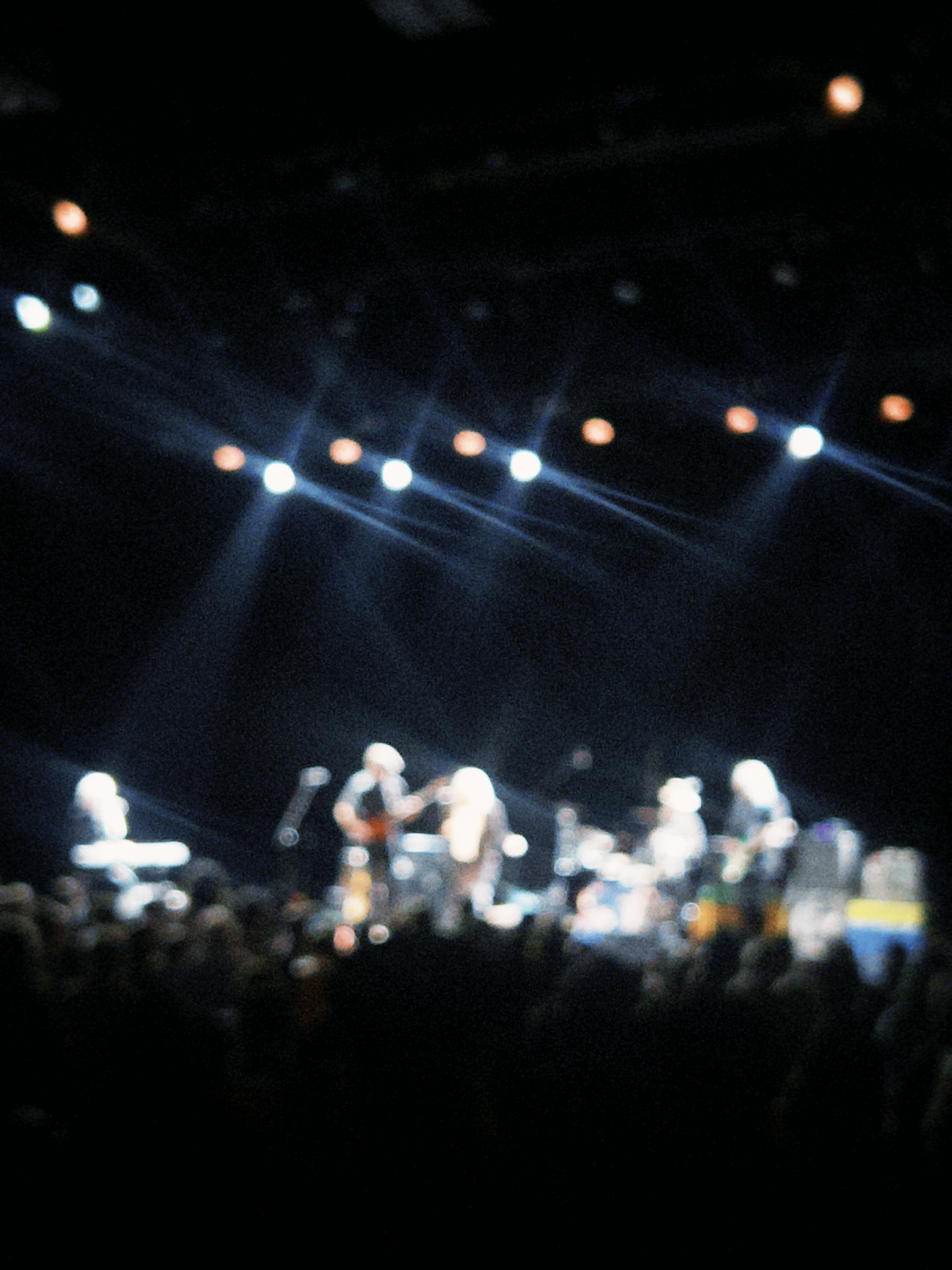
This night also held another special significance, because Chicago is Patti's birthplace. Throughout the show, she repeatedly mentioned her connection with the city. When she moved into “People Have the Power”, her voice tightened with something unmistakably tied to this moment in time. She called Chicago a “city that resists oppression.” Her outpourings were infectious, and the audience rose with her, singing louder and louder with the music as the lights brightened.
Before performing “Horses,” she mentioned Jimi Hendrix’s wish to gather all the world’s musicians and have them play until they found a shared melody, then it will become the language of peace. Today, this wish seems increasingly distant. But Patti still stands on stage, singing of resistance, of peace, of power, and of love in her own way. She constantly proves that music is not just sound, but a power that continuously shapes the world. Her voice is always so strong, so powerful. I’m lucky to have heard and felt all of this firsthand. She carried the spirit of the Beat poets, but there was something in her that didn’t quite belong to them either. People tend to think of rock and roll as collapse or combustion, but Patti has carried a different flame for decades—clear, resilient, relentlessly optimistic. For her, the point was never destruction; it was the act of speaking honestly and boldly in a world determined to shut you down.
edited by Josephine Milea.
photos by Yining Wang.
album artwork believed to belong to either the publisher of the work or the artist.