
These are all songs that stand out in lyrics and instrumentation. These songs are intricate and capture real, raw emotion so that even if the scenario is foreign, the feeling is familiar and evokes empathy or a strong response.
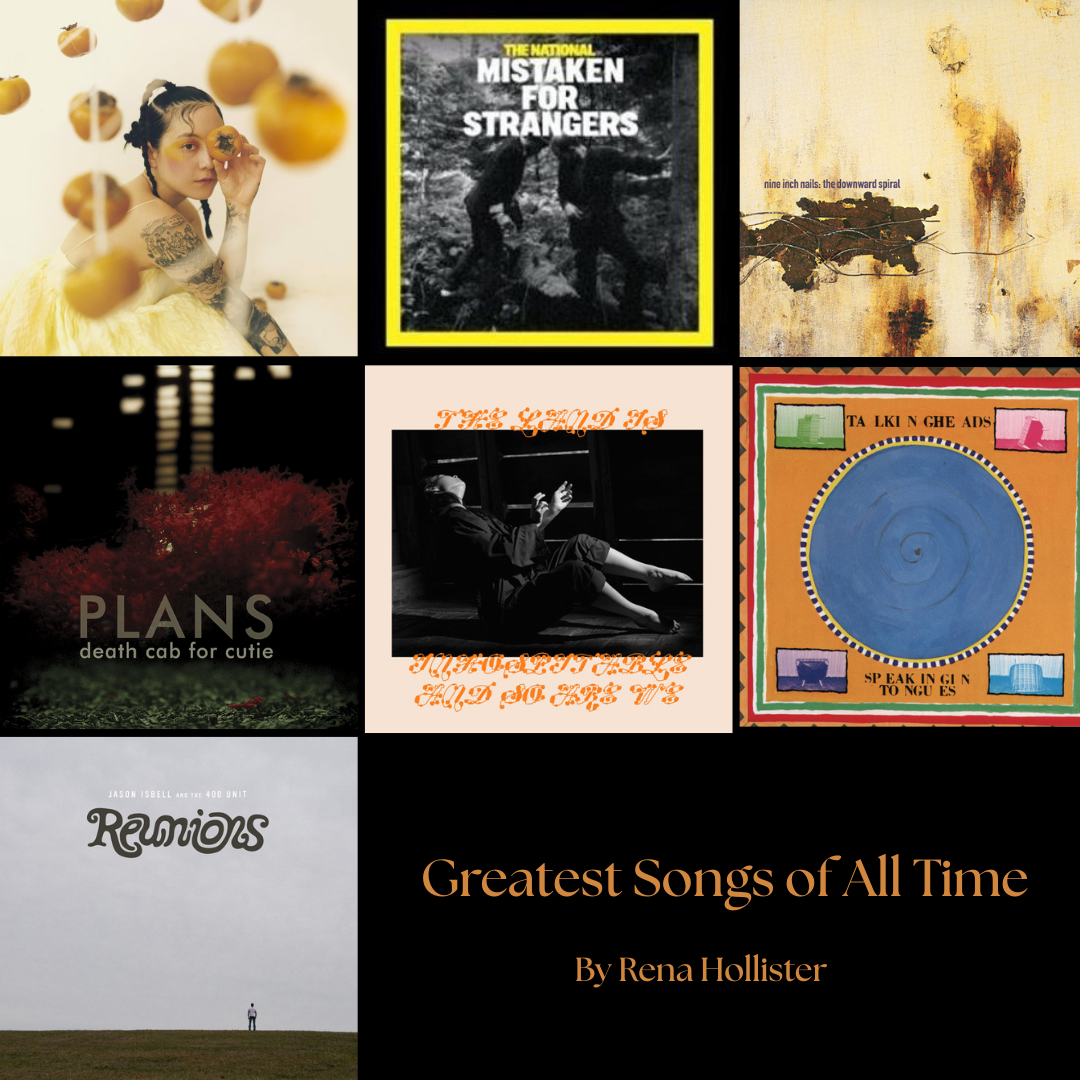
collage by Jake Harvey.
Some honorable mentions:
Kokomo, IN by Japanese Breakfast
A song about friends who grew apart. It has a swaying guitar track that keeps rolling forwards while the narrator is left behind, missing her friend or partner who left. It is called “Kokomo, IN” after the mythical paradise Kokomo of the Beach Boys, but instead this Kokomo is real, and not nearly as glamorous. The song represents leaving behind childhood and being forced to leave your happy Kokomo island for the real world.
This Must Be the Place (Naive Melody) by Talking Heads
Had to include one happy song, or my mother would probably get worried. The band members switched instruments with each other, each playing one they were less familiar with. The melody is also a simple, repeating line, hence the “naive melody.” There is something warm and welcoming about this song. Byrne’s sweet, unusual description of love is what makes this song stand out. It is simple and natural, a testament supported by the simple melody. This song is the equivalent of lying in front of a warm fireplace with your family all around.
Okay. Now on to the Big Five. The happiness ends here. Enjoy!
“Only Children” by Jason Isbell and the 400 Unit
Jason Isbell is a gifted lyricist and storyteller and has some incredible songs that were strong contenders (“24 Frames,” “Running with our Eyes Closed,” “Streetlights,” “If We Were Vampires”), so why “Only Children”? The answer is that it made me cry. I do not mean I teared up listening to it for the first time. This was not like a scene in a coming-of-age film where a single tear rolled down my cheek as I stared out a car window. Well, I was staring out a car window, but I was sobbing. I mean full-on sobbing, ugly-crying even when just talking about the song. So of course I listened to it three times in a row, crying harder each time. It’s that good. A truly one-of-a-kind song that draws you in from the soft opening guitar and holds you rapt until the soul-crushing final lines. This is not an exaggeration.
The first stanza sets the scene of the lonely, lost narrator who sees flashes of his friend in “any kid in cutoffs.” The second stanza is a series of questions directed toward this friend, and the chorus asks about the friend’s present while the narrator reflects on their shared past. The first two “acts” of the song illustrate the friendship of two struggling musicians who fell out of touch, likely due to drugs. The lyrics are dark and regretful: “the hydrocodone in your backpack / maybe these words will hold the beast back.” On my first listen, before the plot twist, I waited for some resolution, a reconnection, anything. Instead, I got hit by a bus:
“Heaven’s wasted on the dead”
That’s what your mama said
As the hearse was idling in the parking lot.
She said you thought the world of me
And you were glad to see
They finally let me be an astronaut.
Please read those lyrics over and over and then listen to the song. Savor it. This is a devastating line. The narrator succeeded with his music career, leaving his friend behind, and his friend died. Even after they fell out of touch, the friend was happy the narrator succeeded alone in their shared dream. The closeness of their relationship is really crystallized here, showing how strong a bond it was that they still thought of, and think of, each other, even after so much time and distance. After the reveal of the friend’s death, Isbell rubs salt in the wound and then backs over you with that same lyrical bus:
Are you still taking notes?
Do you have anyone to talk to?
Castle walls that you can walk through?
And do the dead believe in ghosts?
Or are you lost in some old building
with over-encouraged, only children?
The narrator addresses this song to his friend, asking questions that will never be answered. The repetition of “Are you still taking notes?” paints the lost friend as always curious and eager to learn which makes his fate even sadder. The narrator wonders if his friend found peace in death and maybe found something better in the afterlife, or if he is wandering through an afterlife as lonely and empty as his life with other children who chased out-of-reach dreams. The title refers not to siblingless kids, but the naivete of youth. The duo were so full of hope and light but they were young. Only children. And then the reality of their poverty crushed them and drove them apart. And then the song crushes you.
The Frost by Mitski
Another song about missing a friend. I swear I am okay in my personal life. These are just beautiful songs. This one is unclear why the person is not present. They could have left for work, died, or just fallen out of touch. This person could be a romantic partner, friend, or even a family member; that is also not defined. It’s just a song about seeing something beautiful and wishing your Person, whoever that may be, was there with you. The line that particularly strikes me is “You’re my best friend / now I have no one to tell / how I lost my best friend.” Mitski captures how it feels when you want to talk to someone but just can’t, for whatever reason, and this lack of contact is what you want to talk about. You’re grieving the person’s absence but can’t talk about it with them, and that is painful. Mitski’s voice is soft and lilting, almost like a lullaby, backed by pedal steel guitar and a subdued, jazz-influenced bass. The whole song is contemplative, lonely, and lovely. The final line lingers hauntingly, with Mitski singing “it’s just witnessless me.” All alone, wanting to share your life and thoughts with someone who isn’t there. Part of why “The Frost” is so special is the stream-of-consciousness-like flow. You almost feel like you’re in the attic alone watching the frost settle outside. Mitski’s thoughts seem unprocessed and the song is all the more impactful because of it.
Mistaken for Strangers by The National
“Mistaken for Strangers” describes feeling alienated from your own life and putting on a front. “Showered and blue blazered / you fill yourself with quarters” describes a generic office-work outfit, a staple of many adult lives. The National frontman Matt Berninger used to work in advertising, and was unsatisfied with this job and eventually left to form the band. “Mistaken for Strangers” illustrates how he felt. This theme appears in another song, “Anyone’s Ghost”: “I had a hole in the middle / someone’s slideshow to do,” showing how leaving their stable jobs was freeing and fulfilling.
The chorus is bleak and Berninger’s nimble baritone voice seems to float while the band plays an anxious track. “You get mistaken for strangers by your own friends / as you pass them at night under the silvery, / silvery Citibank lights / arm in arm in arm and eyes in eyes glazing under” starts the chorus, a vivid scene that sounds dreamlike.” Arm in arm, and yet they don’t truly know who their friend is. Isolated in the middle of a group, playing a part in a life that isn’t what you hoped nor expected. This theme is more explicitly stated next:
Oh, you wouldn’t want an angel watching over
surprise, surprise, they wouldn’t wanna watch
another un-innocent, elegant fall
into the un-magnificent lives of adults.
The choice of “fall” and “angel” evokes the concept of a fallen angel, a pure being (light bringer) who surrenders to vices. Children are young and bright and then fall into adulthood and that innocence is lost, yet they still have to act pulled-together and, well, adult.
Bryan Devendorf’s drumming crackles in the background, adding a pulsing, disjointed feel. He is one of the greatest drummers in my opinion. His brother, bass player Scott Devendorf, describes him as a “biological machine” because of his ability to keep such precise time. Yeah, this is a sad, jaded song. But it does it so well. It never sounds bitter, just tired and stuck, until the outro which soars and thunders, expanding beyond the lyrics in a powerful conclusion. The end is a release of the music that held back behind the vocals. “Mistaken for Strangers” sounds like a river pushing through an unnecessary dam.
What Sarah Said by Death Cab for Cutie
Death Cab for Cutie writes some lovely songs. Benjamin Gibbard is a poet and makes even mundane things, like a glove compartment or a Greyhound bus station, feel grand and significant. The man turns worn-down shoes into a metaphor for old age, and makes it romantic and beautiful. He has a gift. In “What Sarah Said” he writes from an even greater height (couldn’t resist a little Postal Service joke), in my humble opinion.
The song is set in the ICU as an unnamed person, perhaps Sarah, lies dying. Later in the song, the narrator says “And it stung like a violent wind / that our memories depend / on a faulty camera in our minds,” which is an incredible line. The first time I heard this song, I kept replaying it and turning the lyrics over in my head. It perfectly describes the pain of knowing your memories of someone will not remain in perfect condition like a video or a photo, but will fade or degrade or be tainted with grief. It is a raw, powerful line that is just beautiful. The “violent wind” is so descriptive and stormy. These lyrics are brilliant. And followed up with a gut-punch: “you were a truth / I would rather lose / than to have never lain beside at all,” a rephrasing of common sayings about love and loss. This is far more intimate. The person was as solid and inarguably real as truth, and the narrator will reel from this loss but treasure the time spent with this person. This line allows a glimpse into the narrator’s emotions, not just his setting or thoughts. It is open and I think it really captures how it feels to lose a loved one who had a beloved presence. Like something was taken away, something you didn’t think could be taken away, and now that it isn’t there, you realize how much you really loved that person. All that emotion in a few words. Brilliant.
Gibbard continues with “but I’m thinking of what Sarah said…/’love is watching someone die.’” Up until those lyrics, the song is building, with Gibbard’s voice crescendoing and the music swelling and rising with a rapid drumbeat. As Gibbard sings “I’m thinking ‘bout what Sarah said” everything falls. There is no grand payoff, no big and bold resolution. Just a sudden softness and quiet, followed by the whispered words “love is watching someone die.” It is crushing. The sudden quiet is devastating because it feels like loss. It just…cuts away. Gone. The music never returns to the way it was before the sudden drop, but it does swell again. This feels like grief. You might not be the same but you will be okay eventually. Gibbard ends the song repeating “So who’s gonna watch you die?” which is a bittersweet description of love. It cuts deep. The instruments drop out one by one, until only a soft, clear synth melody remains, tapering off slowly and sadly. The musical representation of loss and the incredible lyrics make “What Sarah Said” one of the greatest songs.
Hurt by Nine Inch Nails
So, this is in my opinion the greatest song. Ever. I have defended this opinion many a time, especially to those incorrect people who favor the Johnny Cash version. “Hurt” is by no means an easy listen. Trent Reznor managed to write a song that feels like a movie. It is so vivid and emotional. The lyrics feel more like a voiceover and the music is the soundtrack.
“Hurt” is a sharp contrast to The Downward Spiral’s other songs, and to Nine Inch Nails’ discography as a whole. It’s hard to believe “Hurt” is on the same album as the hyper-sexual “Closer” or the jagged “March of the Pigs.” Where those songs are loud and harsh and intense, “Hurt” is fragile and broken and half-whispered.
Reznor’s voice sounds as if it will break at any moment. His shame and frustration are audible. The choppy, discordant notes in the background have the same effect as high-pitched stings in horror movies. The music sounds like purified anxiety, only relieved by the hesitant piano chords during the chorus. The gentle piano is so at-odds with everything else. It stands out for its beauty. It is the most exposed part of the music, without distortion crackling through it, so it stands out. The piano turns “Hurt” into a ballad of sorts, which feels wrong considering the electronic music that threatens to overwhelm. This clash mimics anger masking sadness.
The ending, when Reznor sinks back into a whisper, has the drums rise to an almost scary level. They pound and taper off, sharp and aggressive, like heavy blotches exploding in your ears with no end in sight. The end does come, with discordant, slashing guitar that fades into a soft droning. The droning carries to the very end, almost a full minute of drawn-out tension. It feels like it’s holding its breath, but it never really exhales, not even at the abrupt final note.
The lyrics are deeply personal. “I wear this crown of s*** / upon my liar’s chair” is such an uncomfortable line to hear because it draws Reznor as the lowest of the low, humiliated and at rock bottom. The song hurts to listen to and is about emotional and physical pain. “You can have it all / my empire of dirt / I will let you down / I will make you hurt” shows a person who has nothing–at least nothing that matters to them–yet they would give anything to spare the person they risk dragging down with them. This song isn’t just a window, it’s a portal. It pulls you into Reznor’s mind and makes you witness to another person’s suffering. “Hurt” will linger even after the song ends.
edited by Alexander Malm.
collage by Jake Harvey.
album artwork believed to belong to either the publisher of the work or the artist.