
In most music, a wrong note is a mistake. In jazz, though, you can make it work.
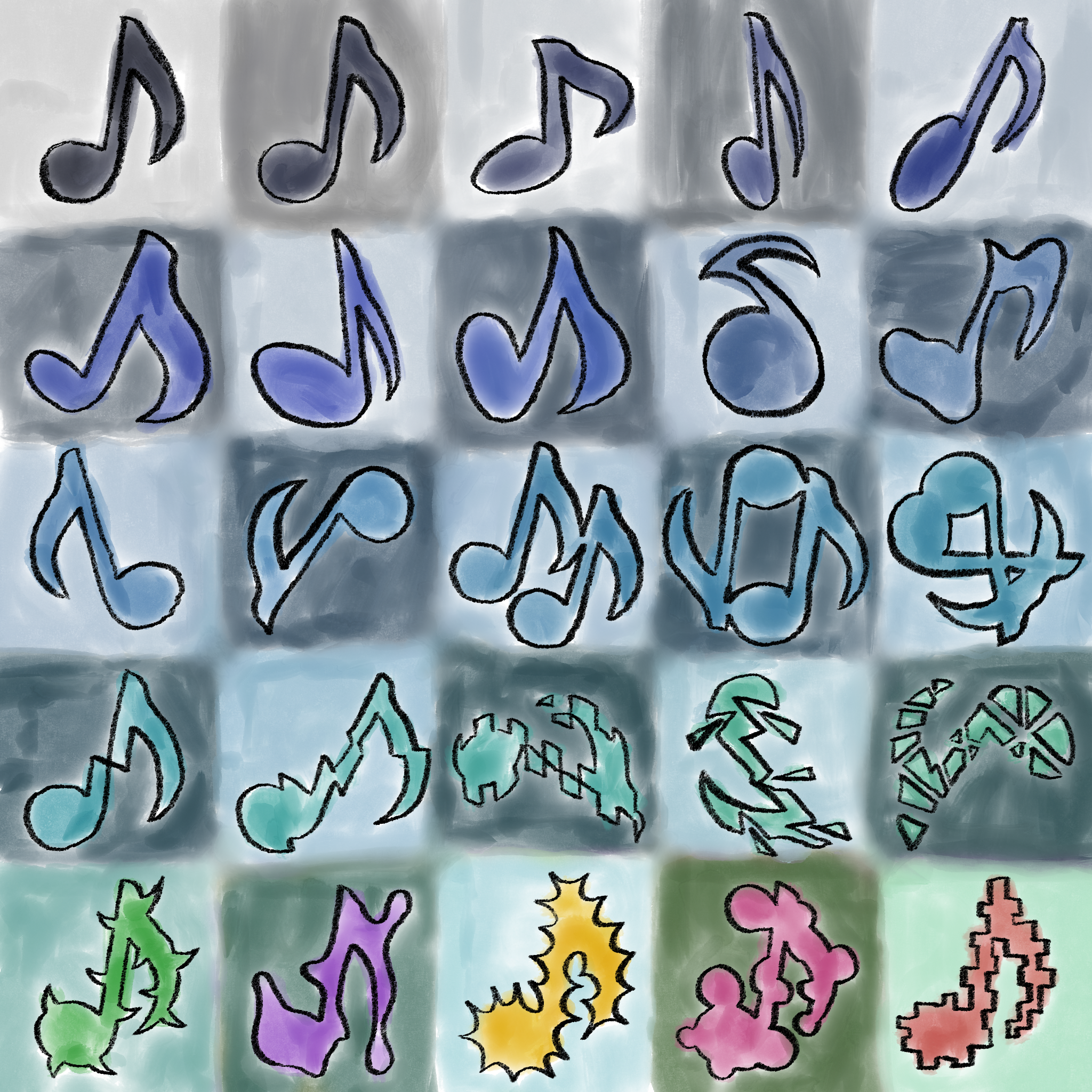
artwork by Asher Stone.
In most music, a wrong note is a mistake. In jazz, though, you can make it work.
That transformation didn’t happen abstractly. Over time, jazz musicians changed how harmony works, turning dissonance from something to avoid into something to use. It was engineered, chorus by chorus, by musicians who pushed against the harmonic and rhythmic limits of their time. If we trace how jazz “broke the rules,” we can follow a clear historical line: from the blues’ bent notes, to bebop’s chromatic explosions, to modal openness and the structural rupture of free jazz.
New Orleans: Bending Pitch Before Breaking Harmony
At the turn of the 20th century in New Orleans, early jazz musicians were already undermining European harmonic purity. At the time, most Western music followed clear harmonic rules: notes fit into specific scales, and chords moved in predictable ways. The blues introduced flatted thirds, fifths, and sevenths, “blue notes” and often bent pitches instead of hitting them exactly. Instead of treating notes as fixed points, they treated them as something flexible.
Trumpeters like Buddy Bolden and later Louis Armstrong played melodies that slid between pitches. On early recordings with the Hot Five in the 1920s, Armstrong reshaped written melodies through rhythmic displacement and pitch inflection.
Before harmony fractured, tuning did.
1940s Harlem: Bebop and Harmonic Overload
The real rupture came in 1940s Harlem, at after-hours jam sessions in clubs like Minton’s Playhouse. Younger musicians felt constrained by the dance-oriented swing format. They wanted complexity, speed, and artistic autonomy.
Enter Charlie Parker and Thelonious Monk.
Parker’s improvisations, documented on recordings like “Ko-Ko” (1945), redefined how musicians navigated chord changes. Instead of staying inside a key, Parker emphasized upper chord extensions (9ths, 11ths, 13ths) and used chromatic passing tones to connect them. He superimposed substitute harmonies over existing progressions, often implying entirely new chord structures within a single phrase.
For example, over a standard dominant chord, Parker might outline altered tones, sharp ninths or flat fifths, creating tension that resolved at the last possible second. To untrained ears, these notes sounded wrong. But they were deliberate harmonic choices drawn from an expanded theoretical vocabulary.
What changed was not just the notes being played, but how they functioned in time. Improvisation became a fast, real-time process of pushing against the harmony and returning to it, where tension was constantly created and resolved within a single phrase. Notes that might sound wrong in isolation gained meaning through their placement, their direction, and their resolution.
Thelonious Monk, working in the same circles, approached rule-breaking differently. His compositions like “Epistrophy” and “Well, You Needn’t” featured angular melodies and dissonant clusters. Monk frequently voiced chords with minor seconds, adjacent notes clashing together, and left space where pianists traditionally filled in harmony.
Bebop didn’t abandon structure. It intensified it. The harmonic framework became denser, and improvisation became an athletic negotiation of tension and release.
Late 1950s: Modal Jazz and the Reduction of Harmonic Pressure
By the late 1950s, musicians like Miles Davis began moving away from bebop’s dense, fast-moving chord changes, which Davis described as becoming “thick with chords.”
On Kind of Blue (1959), Davis and collaborators like John Coltrane and Bill Evans experimented with modal jazz. Instead of cycling rapidly through complex chord progressions, pieces like “So What” stayed on one mode (a specific scale pattern) for extended stretches.
This was revolutionary in its restraint. Without having to worry about frequent harmonic shifts, improvisers could explore timbre, spacing, and melodic contour. A note outside the mode felt less like an error against a chord and more like a color choice.
Modal jazz redefined tension. Instead of arising from fast-changing harmony, it came from melodic shape and dynamics. Silence, breath, and subtle tonal shifts carried more weight. The rulebook thinned out, but that thinning was itself a theoretical decision.
John Coltrane and the Edge of Harmonic Saturation
While Miles Davis moved towards simple harmony, John Coltrane pushed in the opposite direction.
“Giant Steps” (1960) introduced a cycle of key centers separated by major thirds, dividing the octave symmetrically. This progression moved through distant tonal centers at remarkable speed. The structure was mathematically elegant and brutally demanding of performers.
Coltrane’s improvisations layered rapid arpeggios across these shifting centers, creating what critics called “sheets of sound.” The density of information was overwhelming. Harmonic tension became relentless, almost claustrophobic. Coltrane’s work at this stage pushed harmonic complexity to its limit.
The 1960s Avant-Garde: Structure Under Erasure
By the mid-1960s, some musicians began questioning whether this level of harmonic structure was necessary at all. Ornette Coleman led this shift, but John Coltrane himself soon moved in a similar direction.
On works like A Love Supreme (1965), he relied more on drones, vamps, and modal frameworks. Then, in later recordings, he stretched toward free improvisation, where harmony dissolved into texture and energy.
Coltrane’s career alone maps jazz’s journey: from navigating complex rules to questioning whether they were necessary at all.
Coleman’s concept of “harmolodics” rejected fixed chord progressions as the basis for improvisation. On albums like The Shape of Jazz to Come (1959), musicians improvised collectively without predetermined harmonic sequences. Instead of resolving dissonance according to chord theory, they responded intuitively to one another.
In this context, the idea of a “wrong note” nearly vanished. Without a strict harmonic grid, correctness became relational rather than rule-based.
This wasn’t ignorance of theory:— it was a conscious departure from it. Many avant-garde players were formally trained. The freedom they pursued required acute listening and ensemble awareness. The rules were not forgotten; they were suspended.
Relevance to Modern Listening
Jazz’s historical innovations didn’t remain confined to clubs and conservatories. Many ideas developed in jazz, such as extended harmony, rhythmic flexibility, and the creative use of tension, shaped modern popular music in ways listeners often recognize, even if they don’t label them as “jazz.”
Contemporary genres like hip-hop and neo-soul frequently draw on jazz harmony. Producers often sample jazz records, repurposing chord progressions and instrumental textures to create new contexts. Extended chords, those richer harmonies using 7ths, 9ths, and beyond, appear in modern R&B and electronic music because they evoke emotional depth without relying on complex melodic explanation. The harmonic language that bebop and modal jazz expanded has become part of the broader musical vocabulary.
Rhythm, another area jazz transformed, remains central to modern production. Syncopation and groove, ideas refined in early jazz and swing, underpin everything from beat-driven pop to experimental electronic compositions. The concept that rhythm can displace expectations, creating forward motion and surprise, is a direct descendant of jazz practice.
Jazz’s history shows that rules in music are not static. In practice, these rules shape how chords move, how tension builds, and which notes feel stable or unstable. They are tools, frameworks that can be stretched, reshaped, or temporarily suspended to create new forms of expression. From the flexible pitch of early blues to the harmonic expansions of bebop and modal jazz, musicians transformed dissonance and tension into sources of meaning. What once sounded unconventional eventually became part of the musical language.
This legacy matters beyond jazz itself. Modern music across genres continues to rely on ideas first explored by jazz musicians: the expressive use of extended harmony, rhythmic innovation, and the creative potential of tension and resolution. Jazz’s story isn’t about breaking rules, but about remaking them.
edited by Alex Malm.
artwork by Asher Stone.