
Uncompromising and intense, The Sound was post-punk at its finest.
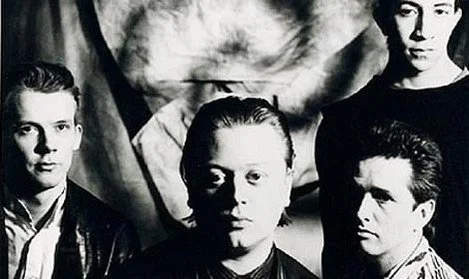
When punk reached British shores in 1976, young people from across the country realized that they could just make music—damn the cost, damn the consequences, and damn the quality. The first DIY punk album, for example, was recorded by three pudgy youths in a family garage, and all they got for it was a couple of nasty reviews in the press. The Outsiders, so named after the Camus novel that they probably hadn’t read (Destiny Stopped Screaming, Simon Heavisides), were a trio of long-haired suburbanites who wanted to take their Iggy-worship to the next level. What they had in musical chops, though, they made up for with an utter lack of charisma. Their album, Calling On Youth, was an erratic collection of pacey riffs, naive enthusiasm, and ill-considered rock’n’roll lyrics that, by virtue of the preposterousness of the sender and the message, earned the wry observation in NME that “they don’t even take drugs.” Clearly, though, they could write a hook and play it well.
Lead singer and guitarist Adrian Borland soon developed ideas of his own about songwriting, which he showcased through the increasingly better Outsiders albums of the late ‘70s. With bassist Graham Bailey, he made weird synth music as Second Layer. With an extended group of friends, he made weird punk music as The Crazies. He also came into contact with a slew of new musicians. Mike Dudley, a friend of a friend who was eight years older than the rest of them, joined the band as a drummer. Bi Marshall, then Bailey’s girlfriend, was brought in after an impromptu performance on keyboard at one of their gigs. With a new direction and new musicians, Borland, who apparently had a penchant for vague band names, rechristened The Outsiders as The Sound.
It seemed, at the time, that this new group was on the verge of something big. Korova, a newly established Warner subsidiary, signed The Sound to a deal, and they immediately got busy, drafting new songs at a breakneck pace. Bands of their ilk—like Joy Division and labelmates Echo & the Bunnymen—were building significant followings. It was under these circumstances that The Sound’s first album, Jeopardy, was released in November 1980.
Jeopardy is an elaboration—the best of The Outsiders, but with new sounds, structures, and subjects. The opener, “I Can’t Escape Myself,” tackles the familiar themes of inner struggle and impotence. Borland is a man overwhelmed by the inadequacy of his will, but he has learned to create overwhelming music by unifying lyrics and sounds in a feedback loop of intensity. In an interview with former Outsiders bandmate Adrian Janes years later, he expressed that “What I am trying to do is total music, where everything bounces off everything else, where a line in the lyrics can be given a subtle hint with the music behind it.” Here, he succeeds, though subtlety is thrown out the window: the quiet of the verses complements his moody contemplations, while the chorus explodes at his frustrated exclamations, which get more and more desperate as the song goes on. The band rations volume like they’re at war, which makes the noise all the more louder when they release the tension. “Just want to break out/Shake off this skin” sings Borland, but he and the band already had. With the building blocks of punk, they had made something original.
“Missiles,” grey-hazy as it is through the fog of war, takes this innovation in form even further. This is a song that marches from beginning to end, rather than from verse to chorus, and the ending is glorious. In between are violent jabs of the guitar and shimmering organs that arrive as though through a wind tunnel. It sounds like missiles. Centered around a refrain that is simple, nearly to the point of banality—“Who the hell makes those missiles?”—the lyrics do enough to really make you wonder, or at least understand the cost.
What these songs, and the rest of the album, have in common is their unremitting honesty. These are people who made music with earnest intention, and if they come off as naive—well, that’s better to have than an excess of irony. If they come off as vague, that’s better than an excess of specificity. Words are for details, after all, and The Sound was interested in sensations.
Jeopardy did well, in the sense that it was a coherent artistic statement that was taken as such. It was fawned over in the press, though a prescient review noted that they would struggle to find popularity. Distribution issues greatly hampered sales, as did the band’s not-particularly-commercial sound. Leading into their 1980 promotional tour, throughout which they were supporting more successful labelmates Echo & the Bunnymen, The Sound had a chip on their shoulder. Things only got worse from there, as hostilities erupted between the two bands. Singer Ian McCulloch parodied “Missiles” with a live rendition of “Who the hell ate those rissoles” and dubbed Borland “the singing pig” (Destiny Stopped Screaming). Borland gave it back, though, and when Bi Marshall started spending more time around the Bunnymen (who, unlike her own band, were helping to care for her through a persistent sickness), she was unceremoniously fired.
1981—new year, new band. Colvin Mayers, the new keyboardist, brought with him a poppier sensibility, in line with the direction that British music was taking through the ‘80s. The Sound, however, refused to fully submit to the forces of the market, which Borland saw as corrupting. This was not always popular with the band. Dudley, whose formative years were before the advent of punk, recounts that while Borland wanted to be “the Velvet Underground of the ‘80s,” he was more interested in being a rock star—that is, having fans and selling records. The label, too, was putting pressure on the band to be more commercial after the poor sales of their first album. It was amidst this discord that The Sound’s next album, From The Lion’s Mouth, was recorded.
FTLM was the club to Jeopardy’s knife. The stylistic edges of the old band had been rounded—replacing their anger with gloom—but not at the expense of their emotional resonance. Borland’s maturation through the adversity of the previous year meant that his songs, while still broad in scope, gained the heft of worldly experience. This is evident from the very first track, “Winning,” which is perhaps the greatest song that The Sound put to tape. There’s no hidden depths here—“I was gonna drown/Then I started swimming”—but what they convey is too distilled, too pure to be delivered in a manner that is anything but direct. And that feeling is not victory, but bloody-minded persistence, because The Sound hadn’t won yet, but they were fighting to be heard, and this was how.
Another highlight is "Possession," which, thematically, is “I Can’t Escape Myself” by a different name. Raw anguish is traded for grim, almost religious determination, which stretches the song taut. Apart from that, though, many of the songs on FTLM are about interpersonal struggle, particularly “Fatal Flaw” and the beautiful “Silent Air,” as though the band had learned to fill the gap between the individual and the geopolitical. It makes them sound older.
Once again, the critics liked it, the public ignored it, and the label wanted something they could sell. The pressure threatened to overwhelm the band. Borland began to drink and grew erratic, picking fights with bandmates (Destiny Stopped Screaming). The recording sessions were difficult. Being who they were, though, the band’s response was uncompromising. All Fall Down, released in 1982, was the band’s darkest record yet. Part reaction, part continuation, its only true fault is that it treads the same ground as FTLM, only less passionately. In “Party of the Mind,” Borland finally crosses over into irony, and in “Song and Dance” and “Where the Love Is,” he struggles to find the line between the vague and the trite. However, “All Fall Down” and “Red Paint” recapture the spirit that animated The Sound’s previous album. It is a great record by nearly anyone’s standards, and still a good record by The Sound’s.
All Fall Down was, perhaps intentionally, a middle finger to Korova’s demands for a more commercial record, so The Sound was booted out. Though they would continue to release good records with smaller labels, success would never find them outside (strangely) of Holland. The Sound’s final album, Thunder Up, stands among their best, but by 1987, Borland had already begun to show signs of the schizoaffective disorder that would take his life, and eventually, a collective decision was made to end the band for good.
Did The Sound win? It depends on how you look at it. They never had the sales of U2 or the influence of The Cure. They didn’t have a singular image or a successful single. But what they did have was the stubbornness to do things their way and to create honest, intentional art. They made music—damn the cost, damn the consequences.
edited by Aidan Burt.
album artwork believed to belong to either the publisher of the work or the artist.