
The Art Ensemble of Chicago, John Coltrane, and Sun Ra offer us an insight into the poetic possibility of politics without words.
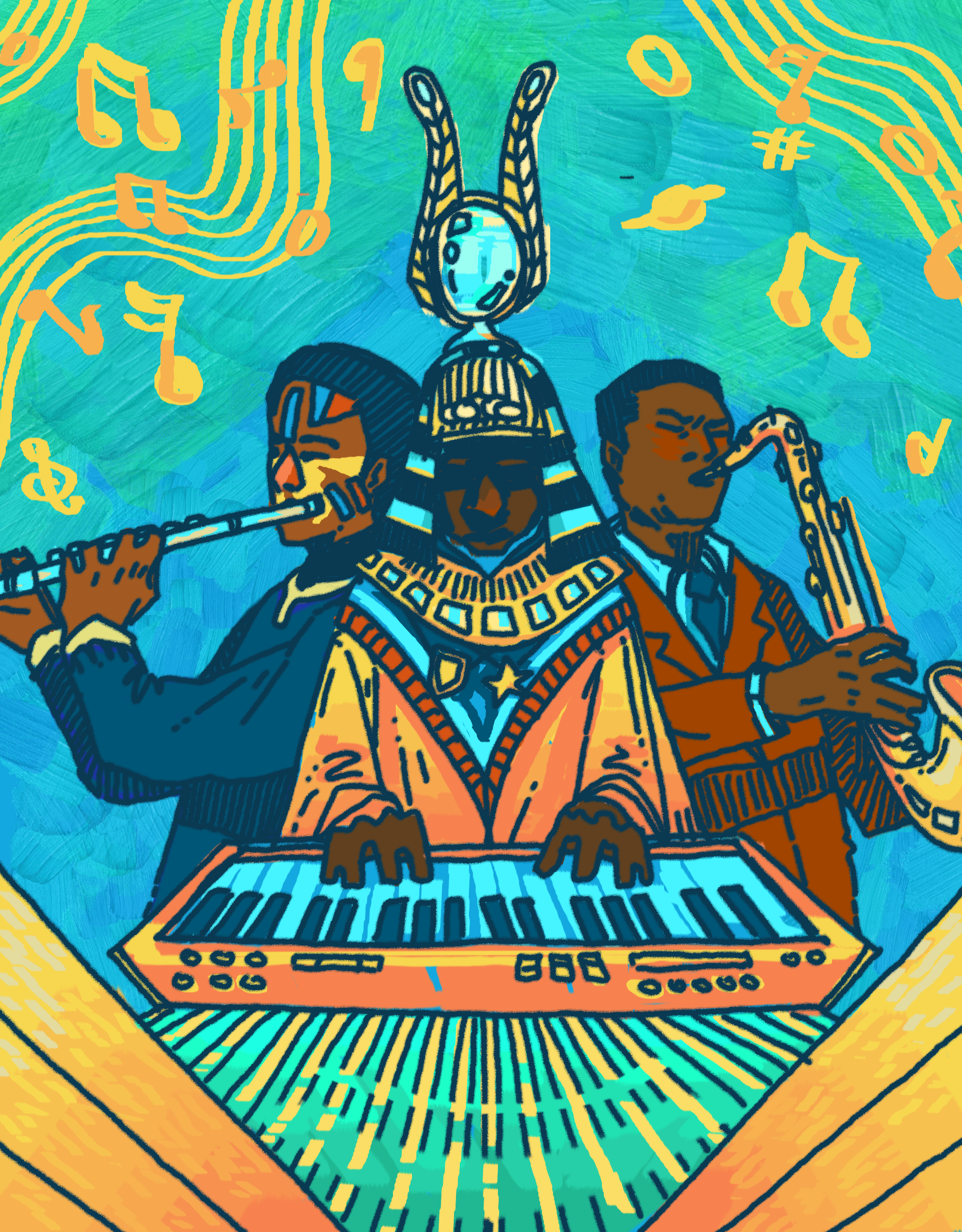
art by Annaelle Le Guellec.
How, exactly, is political music political? When we think of ‘political’ music, we tend to think of two forms: music which is political by its lyrics, and music which is political by the nature of its performance. Neil Young’s discography offers us a handful of illustrative examples of the first kind: “Ohio” warns of “Tin soldiers and Nixon coming,” and that “we're finally on our own,” referencing the violent suppression of an antiwar student demonstration at Kent State University (“Four dead in Ohio”); “Southern Man” points out the hypocrisy of Christian slave-owners and racists (“Don't forget what your good book said”), and asks when the South will make amends (“Southern man, when will you pay them back?”); and “Campaigner” is, surprisingly, a ballad of sympathy for Nixon—Young sings softly that “even Richard Nixon has got soul.” On the other hand, the second category consists mainly of national anthems, traditional military songs, and the like. These not only have patriotic lyrics (which aim to directly instill a nationalist message), but also accumulate a jingoistic spirit through customs of performance which lend them special significance—at major political events, in classrooms, at big games, and so on. Because we repeat these songs in contexts where we self-define our participation within a community with some form of tie to the nation, the anthem becomes a performative utterance, cementing the bond between nation, self, and the particular group at play. With these two modes of political meaning in mind, I want to argue that there is at least one more way that songs can be political: through instrumentation alone. That is, I want to argue that the saxophone, the drum, and the synth can be as political as the written or sung word. We just have to know how to hear these meanings.
“Get in Line” (1969), by the Art Ensemble of Chicago, presents a paradigmatic and undeniable example of political instrumentation. The song begins with the introduction of a rather stochastic rendition of a marching theme, accompanied by aggressive shouts to “Get in line!” and roughly-enunciated marching orders of “Left! Right! Left! Right!” Soon, the relative order of the theme gradually moves from structure to a cacophony that drowns out the accompanying shouts and continues to collapse in on itself as melodies fight and whistles and bicycle horns undermine any remaining musicality. “Get in Line” was released at the height of anti-Vietnam War activism by a band whose original members all served in the military. It is very hard, with this context in mind, for the critique embedded in the song to escape the listeners. The ‘players’ (Malachi Favors on bass, Roscoe Mitchell and Joseph Jarman on alto saxophone, and Lester Bowie on trumpet) are marching soldiers, being commanded by the barking orders (also coming from Jarman). Initially, one might think that the development of cacophony thus stands in for the dispersal of the troop in response to an outside danger, each person moving in a different direction (represented by playing a different melody). But Jarman’s commands for order continue even as they are drowned out, suggesting that this piece actually paints a picture of disobedience. As the players move from rhythm and unity to disharmony, they not only mutiny against the traditional rules of music in the tradition of free jazz, but also, as soldiers, mutiny against the orders of their superior. In the recreation of this mutiny through performance, insubordination is celebrated as just against the injustice of the Vietnam War, and the excesses of the US (as well as the racism of commanding officers) are brought out in the sheer harshness of Jarman’s vocals. “Get in Line” thus puts the listener squarely on the battlefield. Surely, this political meaning is as clear as traditional lyrical meaning, even as the song itself contains no direct references to the Vietnam War.
John Coltrane’s “Alabama” (1963) offers another striking example. The song was recorded in the wake of the 16th Street Baptist Church bombing, in which KKK members bombed a Baptist Church in Birmingham that served as a key civil rights meeting point, killing four young Black girls. Dr. Martin Luther King Jr. delivered a eulogy three days later, his words recorded and spread in newspapers across the country. After reading excerpts of King’s speech, Coltrane was inspired and recorded “Alabama.” Although the piece includes no lyrics, it clearly invokes the rhythm, tone, and even words of King’s speech. The build at the beginning mimics the slow, intentional build at the beginning of King’s eulogy, and Coltrane intersperses the repetition of a motif with significant pauses, just as King’s speech repeats the motif, broken up by pauses, of “They have something to say,” commenting on the significance of the young girls’ deaths for ministers, politicians, the federal government, and African Americans who have “stood on the sidelines.” About halfway through, both Coltrane’s song and King’s eulogy move from a tone of mourning to one of hope. Musician and musicologist Lewis Porter has shown how “Alabama” can even be interpreted as an instrumental rendering of certain phrases in King’s speech. For instance, he hears the key phrase, “They did not die in vain,” at the very beginning of Coltrane’s song. You can see how much you agree with him by listening to excerpts accompanied by ‘transcriptions,’ here. Whether or not you hear the resemblance, we know (from Coltrane’s pianist, McCoy Tyner) that it was intended to some extent.
So, we now have two examples of political meaning being established through instrumentation alone, sans lyricism. Yet, we are still trapped by the spectre of word-meaning: “Get in Line” has its shouts that designate a distinct ‘commanding officer,’ and “Alabama” has political meaning, in part, through evocation of Dr. King’s speech. Both songs, no doubt, give us examples of purely instrumental elements contributing to a political meaning, but they are also dependent on words. We have established a third mode of musical political expression, but have we shown that instruments alone can make sounds with political significance, without any association with speech?
Let’s turn to Sun Ra for help. As you may know, there is a robust mythology behind Sun Ra’s discography, drawing on a variety of mythological traditions. The character of Sun Ra is said to have been beamed down from Saturn, with a message of peace and an offer of salvation for those who escaped Earth with him. Ra did not believe in the politics of this world, but he believed in a politics of going beyond our present station in the universe, and tried to convey the necessity of this through his musical project. For him, the situation of Black Americans could not be alleviated without both a new orientation (towards space!) and a new religious doctrine. He aimed to communicate his truths not only through pamphlets, prose, and poetry, but also through his music. In this way, by drawing on science fiction themes and speculative imaginaries to form a vision for a new Black future, he was an Afrofuturist before the term was coined. Many of his pieces directly (lyrically) speak to his visions for a political future:
Somebody else's idea of somebody else's world
Is not my idea of things as they are
Somebody else's idea of things to come
Need not be the only way
To vision the future
“Somebody Else’s Idea” (1970)
Space is the place, yeah, space is the place
It's no disgrace to want to know
How to live to really be free
“Space is the Place” (1973)
Astro black all outer space
Astro natural of darkness stars
Astro reach beyond the stars
Out to endless endlessness
Astro black American
The universe is in my voice
The universe speaks through this song
To those of Earth and other worlds
Listen while you have the chance
Find your place among the stars
Get into this outer world's
Rhythm, multiplicity
Harmony, equational
Melody horizon speed
“Astro Black” (1973)
But much of Ra’s vast catalogue is purely instrumental. For example, every track (except the last) on his 1978 masterpiece Lanquidity is instrumental. But the experience of Sun Ra’s performances were anything but simple. The live listener was met with a spectacle of a large band (variously called “The Sun Ra Arkestra,” the “Astro Infinity Arkestra,” the “Myth Science Arkestra, the “Omniverse Jet Set Arkestra,” and so on), each member dressed in extravagant, bright, and sparkly robes and hats, many playing instruments that were novel and obscure at the time (e.g. synths). Commanding them would have been the authoritative stature of Sun Ra himself, at times imposing an impressive cohesion of order on the group, and at times sitting back, allowing his players to take on their own improvisational lines of interpretation. Particularly in modern performances (now lacking Sun Ra as the band leader), members of the Arkestra dance around the stage, doing backflips to saxophone solos, and drawing the audience’s visual attention in as many different directions as the music draws their listening. For the listener at home, the experience can still be similarly transformative. Listen to the title track of Lanquidity, for instance, and you’ll hear spacey soundscapes that make you feel like you’re in someplace far-off and new. This imaginative exercise is precisely what Ra wanted to engender, and this imagining is central to the task of Ra’s project and Afrofuturism in general: it pushes us away from reality and into a consideration of what could be. Even without knowledge of Sun Ra’s politics, someone engaged in this imaginative exercise is still taking on a political endeavor, insofar as our ideas of the future are always permeated with an idea of a political future.
But is this not just context determining meaning? In fact, don’t all three of my case studies appear to show context determining meaning? If you approached “Get in Line” with no knowledge of the Vietnam War, “Alabama” with no knowledge of the 16th Street Baptist Church bombing, or “Lanquidity” with no knowledge of Sun Ra’s project, wouldn’t you be lost in trying to find any kind of political meaning?
On the one hand, this is not expressly true. “Get in Line” can easily be read as an anti-war song, even if you do not have the knowledge requisite for placing it as a reaction to the American involvement in Vietnam, “Alabama” certainly evokes feelings of mourning and hope, and “Lanquidity,” as I argue, draws in the implicitly political imagination no matter what. So, without any context, there are still some political meanings that are gained through listening.
Moreover, consider that the lyrical production of meaning in songs also requires context in this way. Going back to an earlier example, you would not be able to understand Young’s “Ohio” if you had no knowledge of the Kent State shooting. It seems, then, that context is always instrumental towards meaning, but that lyrics, custom of performance, or instrumentality can join with context to produce an explicit political meaning. It’s also important to think about how listeners of these songs during their initial release would likely be well-informed about the necessary context. As has already been mentioned, “Get in Line” was released at the peak of activism against American boots on Vietnam soil, and “Alabama” was released just two months after the Baptist Church bombing. To say that these events would not have been on people’s minds as they listened to these songs is the stretch (and not vice versa). As for the case of Sun Ra, I must admit that the context required is a little different. But someone could likely infer Sun Ra’s mystic prowess from the dress and performance of him and his Arkestra on stage, or otherwise learn about his eclectic ideology from his writings, any kind of cursory research, or from the murmurs of the crowd before the show started. Additionally, Ra’s compositions seem to have a marked power to call forth the imagination. One could not infer Ra’s politics from “Lanquidity” alone (in fact, Ra’s politics are more complex than any monograph could convey—he believed in Black emancipation, but didn’t think the NAACP was moving in the right direction; he was also, roughly speaking, adjacent to the Black Hebrew Israelite sect, and chose to vote Republican in 1988 because HW Bush was a Gemini), but, I would conjecture, someone with no knowledge of Sun Ra listening to “Lanquidity,” or any of his other instrumental songs, would still be drawn into imagining an otherworldly future. And again, even if this future is speculative and personal, it will always involve implicit political conceptions—and this kind of imagining is what Sun Ra ultimately wants us to do.
Much ink has been spilled in recent literature on the necessity of a ‘politics of joy,’ a new ‘aesthetic of resistance,’ and other such neologisms for the centuries-old problem of the relationship between art and politics. But perhaps we have spent too much time asking what we need to do to bring art and music back into politics, while neglecting to appreciate the ways in which artists like the Art Ensemble, John Coltrane, and Sun Ra have managed to subtly, yet effectively, bring politics into music. If we want music to take on a stronger political role, we ought to take note of and understand how music alone, even without words, can function as incisive political critique.
edited by Madison Esrey.
art by Annaelle Le Guellec.