With TOOL to go on tour in the following months, an analysis of their most important songs seems the only way to welcome back the legendary band.
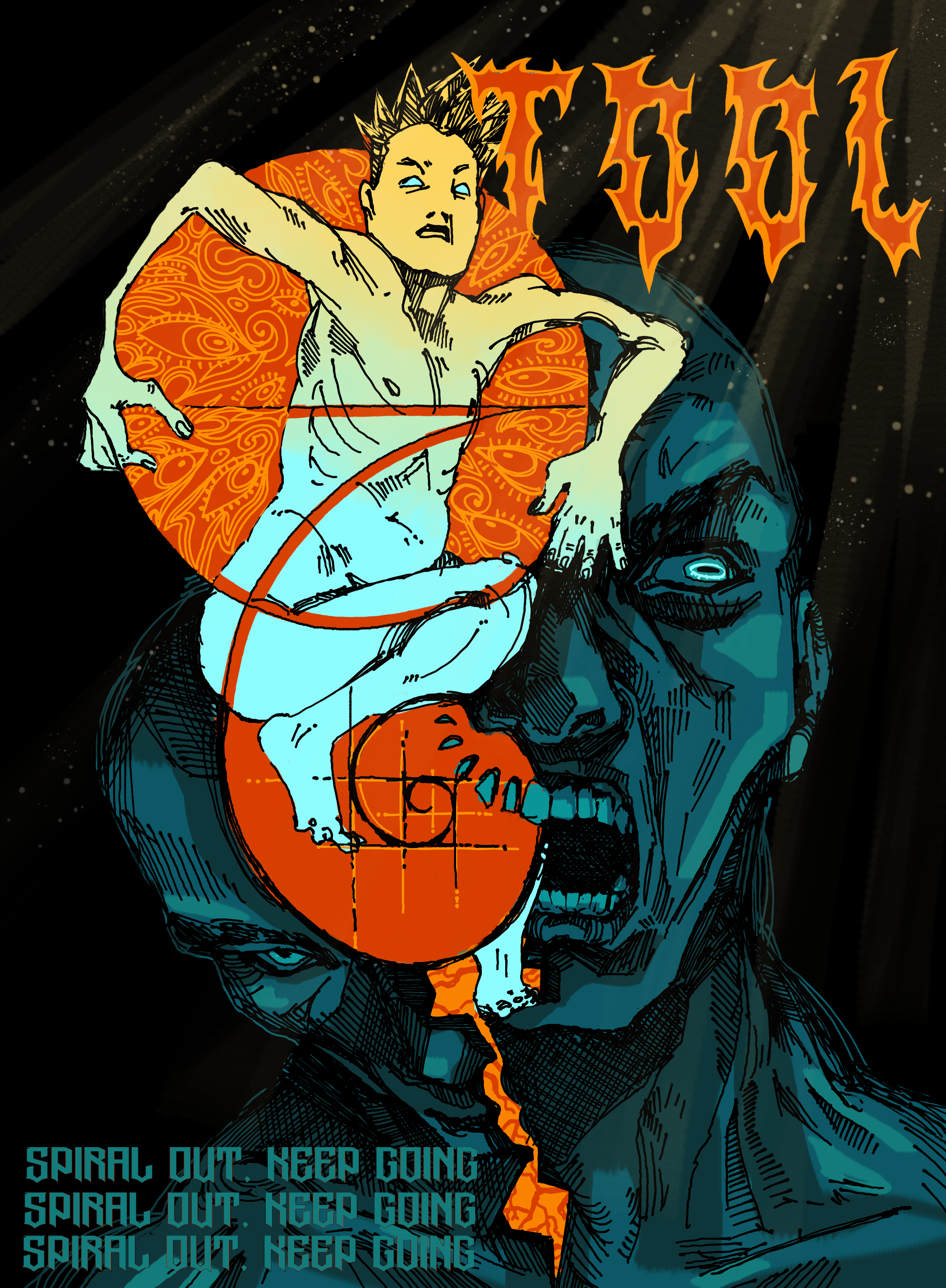
artwork by Annaelle Le Guellec.
“You are dust, and to the dust you shall return.”
It is said humanity is fallen. That we are an accursed species born unto this world only to die. This is seen as a universal truth to many; from the first man’s rejection of Paradise to the modern Hell of other people, our worldly lives are recognized as marred by their very nature. That whether it be divine mandate or rational introspection, our only purpose in this life is to suffer and die- learning little, fearing more. And this is not without reason. I need not expound on the human condition, because the sky is tragically blue (... and this is a music journal), but to quote the ever wise Greeks, “count no man happy until he is dead.” Be it violence, personal tragedy, or an ever damning fate, there is no shortness of pain in the world. Much of it caused by us to ourselves. Such brutality is often cited as humanity’s sister mandate: a propensity towards evil. After all, Eve chose to disobey God. And so it goes that, historically, mankind has been viewed as born to violence and a purposeless end- to find sanctuary only in self loathing or deluded afterlife; that we could ever rise above thought naive by preachers and politicians, sages and sophists. The only truth we have is that we will live, we will suffer, and we will die. And so to dust we shall return.
But what if such a meager existence weren’t so? What if humanity was not bound to this ouroboros of violence and pain? What if our divine mandate was anything but a loop purposeless of blood and dust? What if the fall of man was not the climax of some ultimate tragedy, but the beginning of an ever turning comic destiny? That we may work to free ourselves of the chains the natural order has placed on us, witness the beauty of a universe in which we were necessarily born free, and ride this spiral of fate to a world beyond imagination- that is the true command of humanity. And that is why TOOL’s single Lateralus is a work of transcendent genius.
Lateralus (the album, not the song), is a record of many faces. On one hand, you have songs like Parabol/Parabola serving as deep dives into humanity’s relationship with love and mortality… and on the other, you have Mantra, where we hear the slowed down noises of frontman Maynard James Keenan’s cat as it is lovingly squeezed. To say the least, it is an experience whose point is intentionally elusive- alluringly so. And while I will not be covering the full album in this article, let it be known that it is absolutely worth your time to listen to this piece in full before- or even without- continuing to read. With a recommendation out of the way, and the stage set for the soon to be demonstrated eclectic nature of this album’s self-titled track, let’s talk every music fan’s favorite subject: mathematics.
The Golden Ratio is a number defined by those far above the content of this article (and certainly smarter than myself), but what should be known- and is often appreciated in pop culture- is its ties to aesthetics. From conventionally attractive facial dimensions to the works of Da Vinci, the proportions of the Golden Ratio are present (or at least approximated) in nearly all classical ideas of beauty. In fact, the ever-present nature of this ratio has led many to regard it as the “divine proportion,” seeing its gorgeous appearance as anything but a coincidence- and it's hard to deny such a statement when the Ratio is abstracted. Take the example most paramount to our discussion: the Golden Spiral. Present in everything from the shape of galaxies to the formation of a nautilus’ shell, the Spiral is almost like a heavenly artifact- some secret code of stability in the grand computational workings of the universe. What else could explain its recurrence? The Golden Ratio, and its accompanying Spiral, appear to be ultimate instances of a supernatural splendor- one present throughout all of nature,and one which dictates our very ideas of what it is to be beautiful.
Lateralus has no such elegance.
“Black
Then
White are
All I see
In my infancy
Red and yellow then came to be
Reaching out to me
Lets me see…”
The opening verse’s syllables count up and down what is known as the Fibonacci Sequence, an algorithm whose next number is the previous added to the current (starting from 1, that’s 1, 2, 3, 5, 8, …). Sonically, a rhythmic beating of drums and gentle build up lead to an electrifying climax wherein the verse proceeds. The instrumentation (alongside the lyrics) mimic the birth of a human- quiet darkness proceeded by the vast, triumphant color of a world yet explored. The melodic beginning, and structure of the syllables themselves, hint towards the song’s overarching metaphor: whereas the Golden Ratio and its accompanying spiral represent a perfect divinity, the messier Fibonacci Sequence (which too is able to be spiralized) is a representation of humanity. However, this Fibonacci pattern breaks following the prechorus, wherein the syllable counts of the lines “Overthinking, overanalyzing, separates the body from the mind/Withering my intuition, missing opportunities and I must/Feed my will to feel my moment/Drawing way outside the lines,” appear entirely random. Neither the sum nor individual lines of this chorus/postchorus include a Fibonacci number- except for, “feed my will to feel my moment.” Why? Because in this seemingly random interjection of the pattern lies one of the most important clues to understanding Lateralus: it isn’t just a song about mankind, but of a greater humanity’s dialogue with divinity.
Listening to the song further reveals more of this conversation; the previous verse is repeated with the added lines,
“There is
So
Much
More and
Beckons me
To look through to these
Infinite possibilities,”
maintaining the Fibonacci pattern. Whereas the beginning of the song established the birth of the abstracted man, and the chorus and postchorus showed this human as potentially receiving a form of divine wisdom, this new verse presents a response. Rather than not overthink, or overanalyze, rather than fret over missed opportunities or coloring outside the lines (so to speak), we embrace the chaos. Despite the impossible scope, and the seemingly all consuming nature of seeking knowledge, there’s simply too much which beckons us for a refusal. This verse directly proceeding the birth of this man shows how closely tied our sense of adventure is to the core of our being human; in fact, the one line which follows the sequence during the post chorus- “feed my will to feel my moment”- reads almost as a juvenile demand. We interject this God like being’s sage advice to cry an intellectual hunger our poor creator seems desperate to warn us of. He knows we cannot be satiated, and yet it is all we truly crave.
The prechorus and chorus repeat themselves, only now with an altered postchorus, “Feed my will to feel this moment/Urging me to cross the line/Reaching out to embrace the random/Reaching out to embrace whatever may come.” We once again demand our insatiable thirst quenched and again our caretaker fights back. Do we truly wish to embrace the random? To embrace whatever may come, despite knowing the horrors which await us? And again there is that idea of lines- crossing them and coloring beyond their constraints. In the syllable counts of the two sentences regarding these trespassing, we see another number appear. Whereas the Fibonacci numbers represent humanity, and those breaking the pattern represent the ordering influence of the heavenly Golden Ratio, the number seven is something else entirely.
Since Biblical times, the seven has often been used to represent God Himself- only we already have the broken sequence numbers to represent His influence. So, knowing the historic and religious precedent, what could the subversive TOOL intend with the use of seven syllables? I believe the only possible answer lies again with the Fibonacci Sequence- more specifically, what it approximates. As the Sequence grows, the ratio of its current number to its previous gets closer and closer to what else but the Golden Ratio; as a result, the further you allow the Fibonacci Spiral to grow- the more you “spiral out”- the closer it resembles the Golden Spiral. And it is within these mathematics- the fundamental language of the universe- that the purpose of this divine dialogue is finally revealed: we are not talking to a Father rejecting and warning us as a result of some potential sinful undoing; instead, we are being instructed by this God to take our true mantle as fellow holy creatures. The number seven- typically associated with such holiness- is that representation. It is us caught between our brutal mortality and our eternal divinity, a dialogue within a dialogue. It is the rays of light penetrating a deep, deep darkness we were born to shed- if we are to claim our birthright, we must cross the line.
And so our conversation is recontextualized; rather than question our motives out of paternal concern or holy apprehension, it is a challenge that mankind must answer. Despite the terror that awaits, we will devour to feed our insatiable appetites, we will embrace what cannot be known. And with that, we enter the final stretch of the song:
“I embrace my desire to (7)
I embrace my desire to (7)
Feel the rhythm (3)
To feel connected (5)
Enough to step aside and (7)
Weep like a widow (5)
To feel inspired (4)
To fathom the power (6)
To witness the beauty (6)
To bathe in the fountain (6)
To swing on the spiral (6)
To swing on the spiral (6)
To swing on the spiral (6)
Of our divinity and (7)
Still be a human… (5)”
Placing the syllable count in parenthesis presents the dialogue front and center: humanity’s pseudodivinity accepts its desire to succumb to and connect to the world’s inner workings- to bear witness to what is possible, and embrace the tears which follow. Our creator’s final advice to us is further urging our destiny- that we must feel inspired, understand the beauty of the world, and swing on the spiral. The spiral we’ve been made for. Abandoning the seven- the intermediate of godhood and mortality- we will swing on the Fibonacci Spiral we were born to ride and destined to transmute- all while preserving and vindicating what made us human to begin with.
Lateralus ends with one final march towards godhood. Beginning with seven syllables, the ballad is closed with a verse filled with the repetition of the Fibonacci number eight- a final cry of our mortal selves as we prepare to meet our ultimate transcendence. And with this final verse, TOOL subverts the violent, nihilistic fate which has been passed down for generations. We are not born to die, we do not live to destroy, we are not merely the ash, blood and bone our history has tried to make us. From dust we were made and to dust we shall return, but in the brief moments of clarity we have as humans- as humanity- we can make it mean something. We are given one final Golden command: six syllables repeated four times. A last decree from our creator to take what’s rightfully ours. To take our human Fibonacci Spiral to its very limits, to break through to something we can hardly imagine. To ride this Spiral to the end, “we may just go where no one’s been.” Our story comic justice, our holy demand to thrive. As long as we have breath to draw, let this be our mantra:
“Spiral out, keep going
Spiral out, keep going
Spiral out, keep going
Spiral out, keep going”
edited by Nic Restivo.
artwork by Annaelle Le Guellec.