Despite their frequent characterization as a mere inspirational stepping stone for the most successful pop groups of the 20th century, the Four Freshmen’s early output sings boldly for itself.
On a brisk Los Angeles night in 1958, a local 15-year-old aspiring musician named Brian Wilson shuffled eagerly through a stuffy crowd of patrons at the Ambassador Hotel's Cocoanut Grove nightclub. Light reflected across the smoky room, which was adorned with all manner of gaudy, flamboyant decor—bright red velvet curtains hung from the walls, the perimeter was lined with papier-mâché palm trees; small, star-shaped lights flickered on the ceiling, and a mural of a moonlit waterfall in the tropical wilderness covered the far side of the room. As Wilson forced his way through the throng of chattering guests, he peered up at the venue's small stage, where a spotlight shone upon a set of four microphones and a few instruments. Not only was this one of the first concerts he'd attended, but the performers were a group he'd been studying obsessively for the past few years, their discography a guidebook for his burgeoning interest in songwriting and arrangement. As he sat down at an empty table, his heart raced at the prospect of attaching faces to the dreamy voices he'd heard pour through his home stereo time and again with every spin of his favorite record.
Suddenly, the lights dimmed and the crowd’s din quieted in anticipation, applause ringing out as four men in matching suits stepped onto stage. Each gathered their instruments—a guitar, an upright bass, a drum set, and a trumpet. With their styled hair, poster-boy grins, and flashy outfits, these four young men looked straight out of Hollywood. Wilson held his breath as their soaring, effortlessly coordinated voices began to project through the room, jumping from one textured harmony to another in perfect tune and rhythm. His eyes planted on his four heroes, Wilson would never forget that night. It's what made him commit fully to musicianship, become fascinated with harmony, and aspire to bring the complexity of vocal jazz into the pop radio hits that he loved. That inspiration would lead he and his friends to found the Beach Boys, cementing their harmonic style as one of the most influential in the history of popular music. That quartet, who Wilson would go on to watch perform many more times and whose members he would meet in the coming years, were the Four Freshmen. And they didn't just inspire one young musician, their revolutionary vocal style and critically acclaimed output in the ‘50s and beyond would shape the scope of pop music forever.
Hal Kratzsch and Marvin Pruitt first met brothers Ross and Don Barbour at Indianapolis’ Butler University in 1947, just two years after the conclusion of their service in the Second World War. All music theory students at the school’s small Arthur Jordan Conservatory of Music, the four Indiana natives became fast friends, bonding over a shared fascination with harmony and the emerging genre of jazz. After a short stint performing around college campuses and bars as an apron-and-fake-moustache-donning barbershop quartet called Hal’s Harmonizers, the group grew tired of constrained barbershop arrangements and rebranded. Newly operating as The Toppers, the group’s harmonies sharpened from gimmicky pomp to jazzy angularity as they developed a catalog of classic standards and Tin Pan Alley-style tunes. The quartet soon found themselves in high demand across the city, and by 1948, they had rearranged into their first official form, with members switching instruments and Pruitt dropping out due to stage fright and being replaced by Bob Flanigan, a cousin of the Barbours. With Kratzsch on trumpet and bass vocals, R. Barbour on drums and baritone, and Flanigan and D. Barbour singing first and second tenor and playing double bass and guitar respectively, the group was finally studio-ready.
Sensing the vast potential of their music, the Toppers all dropped out of college to pursue their newfound career full-time. They were soon picked up by agent Dick Shelton, who managed a group with a similar name, so he changed their name to the Four Freshmen (after all, they had only been freshmen when in college). Their break into national recognition, however, came a full two years later. After a gig at the Esquire Lounge in Dayton, Ohio, the group was approached by successful big-band leader and composer Stan Kenton, who was enamored by their sound. A friend told him that they had the power and complexity of a “43-piece ensemble,” and after the show, he was impressed enough to get the group an audition with his label, Capitol Records, who signed them soon thereafter.
Their time at Capitol marked the beginning of their entrance into popular culture, but the success wasn’t instant. Despite releasing a series of successful singles with the label and even being featured in the Hollywood film Rich, Young, and Pretty, Capitol was unsure of the group’s potential—there wasn’t a particularly high demand for their niche of vocal pop. During one period of particularly low performance, Capitol suddenly dropped the group outright and refused to publish their new single “It’s a Blue World.” Furious at this rejection, Kenton fought to secure publishing rights to the song and was able to release it independently. It was met with massive success, becoming the group’s first single to chart nationally and proving to Capitol executives that the Four Freshmen could produce unique, high-quality music on their own terms. From that point on, the quartet was a staple of Capitol’s roster, proceeding to publish a run of hit singles and releasing a series of albums, the most successful of which were their first two: 1954’s Voices In Modern and 1955’s Four Freshmen and Five Trombones.
This era of national success, however, would prove to be short-lived. With Kratsch’s departure from the group in 1953, Don Barbour’s unexpected death in a car accident in 1961, and Ken Errair, Kratsch’s replacement, passing away in a plane crash only seven years later, the group’s original lineup had fallen completely to pieces. Lone original member Bob Flanigan was able to find replacements, but despite these newcomers’ talent, their efforts to produce more charting music fell flat. Just a few years after their big break, the Four Freshmen’s style had become all but obsolete. They never stopped trying, though—the quartet has maintained a consistent following through a series of lineup changes that have carried it all the way into the modern day. In total, they have recorded 50 albums and received six Grammy nominations, with approximately 26 total members having participated in the group over its 78-year history. Although their mainstream popularity was cut short, the Four Freshmen’s legacy has had an enormous impact on the music we love today. Their style has influenced fellow vocal artists like the Lettermen, the Four Preps, and the Manhattan Transfer, while also inspiring arrangements for pop groups like the Mamas & the Papas and, of course, the Beach Boys—Brian Wilson credited them as his main influence in crafting the band’s harmonies, hired their arranger to help him with multiple projects, and regularly traveled long distances to see them perform. Additionally, spirited fans have gathered at Four Freshmen conventions across the nation for over three decades and the modern iteration of the group continues to tour around the world.
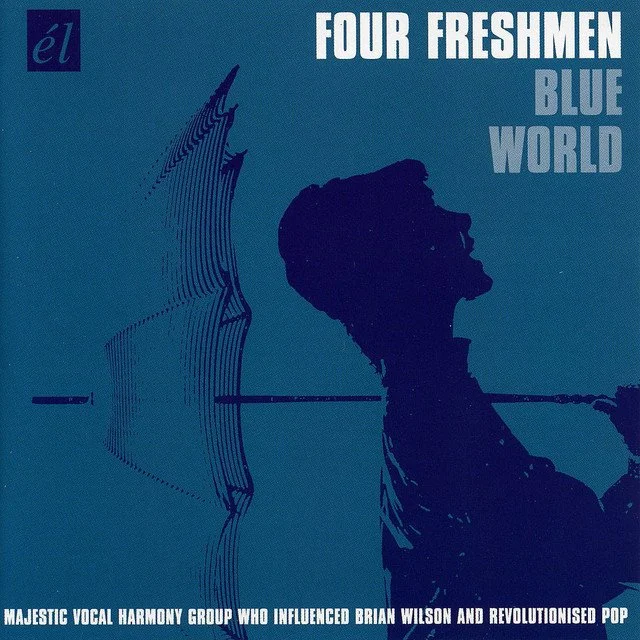
While their legacy has clearly endured, The Four Freshmen have never been able to top the success of their early output. The first few years of their catalog, characterized by fresh and passionate performances that abound with the excitement of newfound fame, carry an unparalleled magnetism. That’s why, in 2006, London-based independent reissue label él Records produced Blue World, a compilation of the Four Freshmen’s early work that would go on to be their most enduring release in the digital age. A sampling of recordings from the years 1950-55, the record assembles 20 of the strongest and most influential songs from the group’s lengthy discography, leaving us with a refined, spirited, and shockingly modern tracklist that takes its listeners on an all-encompassing sonic journey. Leaning into the quartet’s legacy, the album’s cover brands them as a “Majestic Vocal Harmony Group Who Influenced Brian Wilson and Revolutionized Pop,” while the back further highlights their modernity, reading: “A pre-echo of the sixties, The Four Freshmen created a revolutionary new style of close harmony vocals… ‘Blue World’ showcases their pioneering first five years of recording: a programme of hit singles and outstanding selections from such landmark albums as ‘Voices in Modern’ and ‘Four Freshmen and Five Trombones’ that over half a century later still sound extraordinary.”
This record’s selection, however, isn’t just an arbitrary assembly of the group’s hits—it seems to be curated to fit within a specific emotional framework. As suggested by its title and cover, which depicts a dark blue silhouette of an open-mouthed man with his head tilted towards the sky and an umbrella cast over his shoulder, Blue World emphasizes the melancholic above all else. This may not come as a particular surprise—the songs that cut through the rest by evading the marks of dated corniness would obviously be those that capture timeless and potent themes like heartbreak, dejection, and the trials of romance. In an age when social conservatism and emotional suppression have fallen completely out of favor, it could be argued that we hold our music to a higher standard of depth and authenticity than ever before. The barbershop/a capella tradition into which the Four Freshmen loosely fit isn’t necessarily known for its thematic depth—it focuses much more on harmonic performance and execution and contains a degree of baked-in hokeyness. What better way, then, to make the group’s style compatible with modern trends than to select only their most emotional pieces? The profundity of sadness is, after all, not very easily diluted by time—take this record as proof.
The album opens with “Now You Know,” a tight and perky romantic number packed with sweet, fluttering harmonies that eases us into the group’s signature sound. The true mood is set, however, by the following song—eponymous track “It’s A Blue World.” The tune kicks off slow—first one low howl meanders alone across the soundscape, as if lost and searching for company. It is quickly joined by a chorus of pained voices, wallowing at first in distant harmony before reaching a louder, layered climax which enters the foreground for a unified moment, eventually flickering back down into its initial foggy lament. For a moment we’re left with a blistering silence. Then, slowly but surely, the fog parts and the voices creep back, delivering us the first lyrics of the piece. They are joined by minimalist instrumental backing, Ross Barbour’s brushed drums swinging slowly along and his brother’s guitar strumming with pensive reservation. Meanwhile, Flanigan explores unique rhythmic figures on the low end, highlighting the piece’s wide and balladic pocket. The lyrics do well to match the woeful dirge of their accompaniment as the group sings: “It’s a blue world from now on / It’s a through world for me / The sea, the sky, my heart and I, we’re all an indigo hue / Without you it’s a blue, blue world.” A tight 2:57 later, we’re left in a puddle of contemplative misery—that is, until “Stormy Weather” comes on.
As cohesive as Blue World is, él’s selection suffers from the occasional misstep. The record does an excellent job of collecting all of the group’s thematically downcast songs, but doesn’t do well at distinguishing which songs in that selection match their sound to their material and which, in favor of ditzy, dated theatrics, don’t. “Stormy Weather,” wedged between two of the group’s most powerfully melancholic tracks, illustrates that contradiction with flying colors—not only does it turn the album’s solemn spirit on its head, but it does so with brash indifference. Originally written in 1933, this bluesy swing tune isn’t corny in and of itself, but the group’s hammy execution renders any impact aside from self-mockery obsolete. Blasting horns, jaunty instrumental accompaniment, raucous background shouting, and Flanigan’s exaggerated, vibrato-laden lead vocals give the song a lighthearted but tragically antiquated feel. As the album continues, a few other tracks—most notably “Baltimore Oriole” and “Mood Indigo,” fall prey to a similar misplacement and overall sense of outdatedness. These songs injure the narrative that él seems to portray with this record—fun as it may be, this goofy faux-crooner anthem is a swing and a miss both for the scope of Blue World and the conventions of modern music.
Luckily, any wound inflicted by “Stormy Weather”’s cornball sensibilities is immediately mended by the heartwrenching power of the following track, “The Day Isn’t Long Enough,” which sees its narrator in the throes of a dreamy love affair. It’s positive on the surface, describing a connection so strong that the narrator wishes he could make every encounter with his lover last forever. The mournful harmonies of this piece imbue it with a tinge of sorrow, though—its wistful air and the tangible pain in each singers’ voice don’t lend themselves to unadulterated happiness. Whether intentionally or not, the Four Freshmen’s devastating performance suggests additional depth. Perhaps it chronicles the loss of a relationship, the narrator feeling that no matter how long he’d spent with his departed lover, no day was ever long enough to appreciate them in full. Simple, synchronized vocals preside over the piece’s opening section, then rise into a tremendous outburst at its refrain—the real tear-jerker is our four narrators’ admittance that, in that dense climax when all the voices seem to have sprawled to their most tortured, “just when there’s happiness / the day is all gone.”
Unfortunately, around the song’s 1:35 mark, this display is punctuated by a piercing jump-scare of a trombone solo that suffers desperately from lackluster mixing. As skillfully as the quartet control their individual vocal volume levels, they seem occasionally to struggle at channeling that smoothness on their instruments. As user R.E. Statham aptly writes under the header “Don’t Bother” in the only review of the Blue World CD on Amazon, “[There are] tight vocal harmonies, but the mediocre musicianship in much of the accompaniment… gets old quickly. The trombone accompaniment is... well, a C+ at best. Sharp, loud, brassy and obtrusive. [It] clashes with the nice vocals.”
The strength of the record’s opening chapter is further exemplified by the group’s rendition of jazz standard “Poinciana.” An adaptation of an old Cuban folk song written in 1936 by Nat Simon, “Poinciana” has garnered significant attention via the talented cast of musicians who have covered it—Ahmad Jamal, Glenn Miller, Frank Sinatra, Bing Crosby, Sonny Rollins, Nat King Cole, Keith Jarrett, Chet Baker, Vulfpeck (I had to throw them in)… the list goes on. Not only does the Four Freshmen’s moving take on this classic piece measure suitably up to its counterparts, but it may even exceed them in impact. Its brief opening harmony soars with breathtaking majesty—the quartet’s isolated vocals flare up in intricate formation before being joined by calm, unobtrusive instrumentation. The lyrics are by far some of the most poetic and mysterious in the compilation—this piece seems to tackle a more profound and philosophical subject matter than the other songs, evoking vivid natural images such as a “pale moon… casting shadows from above” and a “blow[ing] tropic wind sing[ing] a song through the trees.” The song’s contagious, sentimental sense of hope is brought to its most potent during a sweeping climax into the final verse. The outro brings the energy down and the beauty up, a tribal tom beat and swooping bass line accompanying the vocals in a gorgeous ritardando which sees the harmony cascade to a chromatic conclusion. “Poinciana” is truly larger than life, encapsulating an elusive, fleeting worldly magic that carries its impact long past the three minute mark.
This isn’t the only recognizable song present on the album, either—Blue World’s second chapter sees the group apply their clean-cut harmonic format to a number of classic Great American Songbook tunes with varying degrees of success. Their rendition of Sammy Fain’s 1938 standard “I’ll Be Seeing You,” despite a technically strong performance, is rendered weightless when placed next to other takes on the tune, most notably Billie Holiday’s famous, crushingly emotional rendition. It’s just a little harder to buy it when a group of dashing, masculine prom king college bros with matching suits and hair greased with Royal Crown pomade sing that, “I'll find you in the morning sun / And when the night is new / I'll be looking at the moon / But I'll be seeing you.” What this song loses in warmth is made up for, however, by the quartet’s ethereal performance of Harold Arlen’s “Over the Rainbow” (made famous, of course, by Judy Garland in The Wizard of Oz). Their graceful instrumentation flutters aback dense and jazzily literate harmony. Like all of this album’s best renditions, “Over the Rainbow” highlights the beauty and genius of the original composition while showcasing the quartet’s mastery of chordal exploration.
“It Happened Once Before” and “After You,” two standout tracks from Voices In Modern featured in Blue World’s middle chapter, feature similarly tight harmonies and further the established wistful ambience, painting vivid portraits of vintage romance without the surface-level kitsch of their weaker counterparts. “It Happened Once Before” sees the group cautiously easing into a new relationship while facing bittersweet memories of past loves, singing “It happened once before / Her kiss seemed true like yours / And when I held her in my arms / My heart felt warm, and when / I hold you close to me / I feel that same old warmth again,” while the narrator of “After You” suffers in the throes of an ugly breakup: “After you / All my laughter is gone / Laughter you / Taught my heart to live on.” Their scope and subject matter lend themselves excellently to the group’s sound, format, and personality, and the singers operate at full tilt through both tracks, spinning complex harmonies with effortless fluidity. This is Blue World at its best.
The final chapter of the record contains a series of orchestra-backed tunes from the early Capitol years that, while carrying the mood forward, lose some of their depth to datedness. Songs like “It Never Occurred To Me,” “How Can I Tell Her,” and “In This Whole Wide World” hit every melodic mark, but lose their modernity and weight to tropey, Hollywood-ready orchestral backing that sounds straight out of a Fred and Ginger movie. Between two of these songs sits “Day By Day,” a refreshingly spiffy and radio-ready number and the group’s highest-listened song on Spotify. While él may have made a questionable choice working this abrasively jolly tune into the compilation, the song itself is tight, fun, and spirited in a way that not many other tracks parallel.
The album concludes with a reclamation of its identity, drifting away from the swelling strings and blaring horns of its bubblier tracks and returning to pensive form. “Mam’selle,” a notable cut off of Four Freshmen And Five Trombones, sets us in a loose, loungy atmosphere with swinging piano accompaniment and well-balanced horns, while “Speak Low” pulls off its Bobby Darin-esque crooner theatrics with refreshing tact. The saccharine “Our Love Is Here To Stay” features soaring, relaxed harmonies and flavorful dissonance that guide us to a serene conclusion, its lyrics putting the consumerist American soundscape of the ‘50s into perspective: “The radio and the telephone and the movies that we know / May just be passing fancies, and in time, they go / But oh my dear, our love is here to stay.” The final track, aptly titled “We’ll Be Together Again,” is a slow and ponderous tune with minimal backing, contrasting the sweeping orchestral and horn-laden chapter from which it came and placing us on a soft pillow of tight harmonies, relaxed instrumentation, and only a slightly obnoxious trumpet solo. As cheeky a move as él may have made with this placement, one can’t help but feel personally addressed when our four friends sing “For parting is not goodbye / We'll be together again” to close out this rollercoaster of a record.
Despite the Four Freshmen never quite becoming a household name, their brief period of mainstream success and the audiences it impacted have irrevocably sealed them into the canon of music history. Whether you’ve heard their pioneering harmonic style on “Poinciana” or “God Only Knows,” their influence remains a driving force in both the jazz and pop traditions. Blue World doesn’t only stand as a testament to their legacy and an illustration of their technical ability, though—it offers us a vivid window into the woes, thrills, and ponderings both of an entire generation of songwriters and an audience that found renewed respite in their work. The Four Freshmen are responsible for the magnification and reinvigoration of the Great American Songbook’s impact, their trailblazing renditions of its songs proving that truly talented songwriting and performance are timeless. And as dated as much of Blue World’s tracklist may sound, stripping away the sterile varnish of old-school sonic sensibilities leaves us with so much more than a charming gimmick. The quartet spins these universal tales of love and pain in a way that is tangible, delicate, and bracingly human.
edited by Levi Simon.
album artwork believed to belong to either the publisher of the work or the artist.