Reflecting on the cycles of life and once-lost memories through psychedelic pop.
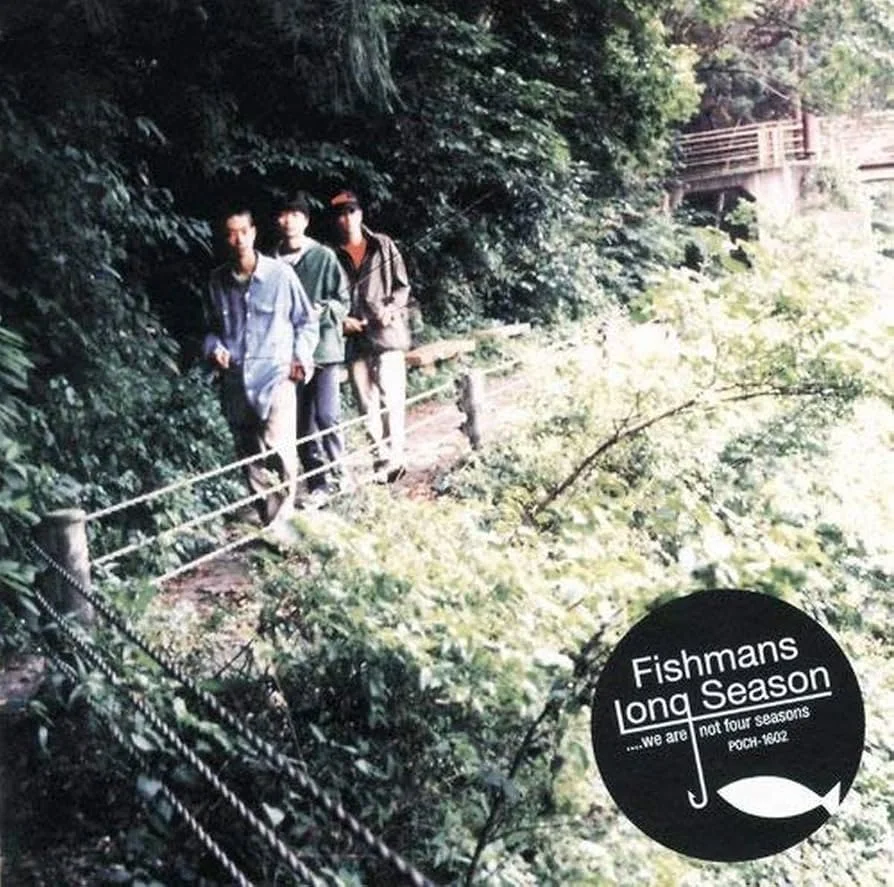
It’s November 29th, 1996, 11:00 p.m. People have just begun to shuffle into a live music venue located in Shinjuku, Japan. The iconic American rap trio De la Soul is scheduled to perform in about six hours, and in the meantime, the audience will be treated to a performance from an up-and-coming band: Fishmans. On this night, in front of a crowd of only a few dozen, the now-iconic band would perform their magnum opus, Long Season, for the first time. It marked the beginning of a much-too-short era. They would continue to perform the one-song album live for two years, culminating in their landmark performance at the Akasaka Blitz on December 28th, 1998, which would later earn online recognition as one of the best live performances of all time.
The first time I listened to Long Season, I didn’t know much about it. I saw it mentioned on a video about the best live performances of all time, and just decided to put it on while I worked. I wasn’t giving it my full attention, nor was it really inspiring me to. It wasn’t that the song was bad by any means, but rather that the repetition lulled me into a trance as I typed away at an essay. Then, nearing the end of the song, as Honzi’s accordion started the build-up to the finale, I checked the time left on the song and was surprised to find thirty minutes had passed. It had felt like only ten. I took a break from my essay to fully appreciate the end, then restarted the song and got back to work. After I finished, I went and listened to the live version as I lay in bed, and looked up the translation to the lyrics. Over the next two days, I listened to Long Season repeatedly, noticing new details each time. Soon after, I listened to the live version and subsequently watched the accompanying recording. Anything I could find that was related to the album, I read or listened to. I ended up listening to various versions of the song about twenty-five times in the two weeks following my initial discovery. Something about the song just had me addicted. Lead singer Shinji Sato’s voice is uniquely haunting and perfectly fits the song. The repetition of the piano is hypnotic, Sato’s guitar is amazing, especially in the live version, and Honzi’s performance on the violin, accordion, and vocals adds perfectly to the song’s cinematic feeling.
Long Season is all about memory and the passage of time, and the band makes sure you feel it. The song sounds something like a dream, or going in and out of reality. The use of repetition to create a trance-like listening experience makes the sudden changes in the song feel even more drastic, and then the eventual return of previous elements is almost comforting, in a way. The lyrics are sparse and usually open-ended, leaving space for plenty of interpretations. For the specific lyrics, I will be looking at the live version because it is my personal preference, and it should be noted that these are not exact translations. The first verse describes two lovers exploring Tokyo at dusk, and ends with Sato reminiscing, “We were halfway in a dream” before asking (from what seems to be the second perspective), “What is that song you’re humming/What’s on your mind?” Sato quickly paints a scene of two people: one lost in a memory, and the other asking about it. The next verse offers clarity as it details the two driving in a car, with a sunset in the rearview mirror. Returning from his memory, Sato remarks, “Feeling kinda happy, feeling kinda lonely/Seems like I’ve been done in by my cold medicine”. Despite clearly being in the company of somebody else, the song’s protagonist has been completely enveloped by their past, ignoring their companion completely and instead looking back on a bygone experience. Soon after, Sato repeats the phrase “Get round in season” before sending off into a fourteen-minute instrumental. As far as I know, this phrase has no agreed-upon meaning, but I interpret it as a sort of “see you later” to this specific memory. Even as the pair drives off into the distance, the driver knows that this memory, or maybe the subject of the memory, will come back eventually. After the instrumental and another appearance of “Get round in season”, the lyrics continue with a repetition of the first verse and the similarly-echoing refrain of “What is that song you’re humming/What’s on your mind”, before ending with Sato’s angelic voice singing “We were halfway in a dream”.
I can’t say I’ve ever had a song or album reach me at such a perfect time in my life before. Or any piece of art for that matter. Long Season has brought back so many memories throughout my numerous listens, and has certainly played a role in my outlook on my college experience. To me, this song represents the feeling of sudden nostalgia interrupting everyday life, and as a first-year college student, it has felt especially moving over the past few months. Before starting at UChicago, the vast majority of my dearest memories were composed of my high school friends—the majority of whom I now haven’t talked to in months. This album has often served as a melancholic reminder of my high school experience, and been a catalyst for reaching out to some friends I hadn’t spoken to in a while. As for the passage of time, there are two weeks left in the school year as I write this, and it hardly feels as though the ten weeks we call a quarter have passed. We are so often lost in the cycles of our lives, and the experiences that built us can be forgotten far too easily, but they will always come back to us. Long Season perfectly encapsulates these moments in which these memories return. If you are especially missing your friends from home, a family member, or maybe just love psychedelic pop, there are no albums I would recommend more than Long Season.
Fishmans’ December 28th, 1998 performance at the Akasaka Blitz would mark their final time playing together as a whole. Bassist Yuzuru Kashiwabara left the group after losing interest in his musical career, and only three months later, Sato would tragically die of heart failure on March 15th, 1999. After his death, Fishmans would only release compilation albums of previous works and eventually perform live concerts in his honor. The remaining members dispersed to other bands, but Fishmans’ popularity would only grow over the years. Thanks to DVD recordings and online forums, the band grew in popularity online before eventually being added to streaming services in 2018. Today, their music only continues to spread across the world, and new and old members, including Kashiwabara, have since reunited to perform concerts as recently as October 2025, although they have not released any new albums since 1999.
edited by Sebastian Torres.
album artwork believed to belong to either the publisher of the work or the artist.