
A ‘Counter-Review’ of Karly Hartzman and MJ Lenderman Live at Third Man Records.
Not every great live album needs to chase excitement. A defense of Karly Hartzman and MJ Lenderman’s Live at Third Man Records that finds beauty in its slowness, looseness, and post-breakup melancholy.
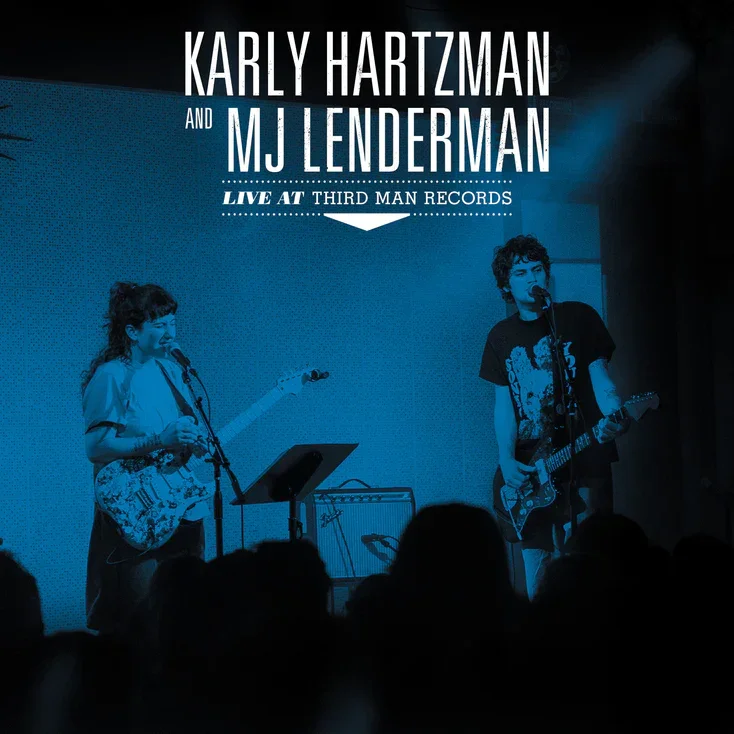
December, 2025, Stephen M. Deusner wrote a Pitchfork review for Karly Hartzman and MJ Lenderman’s Live at Third Man Records, estimating it a sickly score of 5.9/10. Deusner admits—and this a conviction I share, to lay my cards out on the table—that Hartzman and Lenderman are two of the best singer/songwriters out there today. But this live album, recorded so shortly after Lenderman announced their breakup with an awkward interjection in an interview with the New York Times (“I guess I should mention me and Karly broke up”), falls flat for Deusner; it “lands with a finality that the duo perhaps didn’t intend.” For me, as I’ve been listening to the album, again and again, over the last few months, Deusner’s analysis is what falls flat. Live at Third Man Records isn’t a masterpiece, but it’s a unique and memorable entry in the history of both Hartzman and Lenderman’s careers.
Two things stand out immediately when you listen to Live at Third Man Records, originally recorded on September 18th, 2024 at the Blue Room in Nashville. One, the setlist is a hodgepodge of covers, songs from the artists’ individual catalogues, and songs from the recorded collaborations between the artists (How Do You Let the Love Into the Heart That Isn’t Split Wide Open, Guttering, and over half the tracks on Mowing the Leaves Instead of Piling ‘em Up). In this way, there is indeed a sense of finality, as if Hartzman and Lenderman are giving these projects that they worked on together one last hurrah, especially as they rarely played songs from them in the past. Two, as is common with Lenderman’s live playing in particular, everything is more drawn-out, less neat or tight than it is on the records. Yet, we should remember that the two both began their respective careers with slower, feedback-laden songs, as compared to the punchier, catchier tunes they've become known for today. This choice of style, too, almost seems like a callback then.
Deusner is right in calling this a low-energy set. What’s so wrong with this? His Pitchfork review opens with the complaint that the central ‘moment’ of the performance of “Wristwatch”—according to Deusner, this is the iconic line “I got a houseboat docked at the Himbo Dome” (even though this is arguably not the climax of the track)—is not really sung along with in the recording. So what? Are we supposed to define the quality of a piece of music by the audience’s reaction? There’s something to be said for the excitement that comes with lots of live recordings in particular, in hearing people share your own level of enthusiasm for the songs and the artists, in hearing a chorus of voices remembering lyrics, in imagining that you were there, and indeed, in these respects, Live at Third Man Records does not deliver.
Still, just because this isn’t “that kind of show,” as Deusner says, does not mean that it’s ipso facto a bad show in the first place. We come into concerts with a certain set of expectations, usually based on what we know about the music, its genre, and its performers, and understandably, people who had only seen Hartzman or Lenderman in more energetic performances may have been disappointed. Listening back, however, we shouldn’t be plagued with this anticipatory attitude. Hartzman and Lenderman often take the “slacker” in “slacker rock” very seriously. Lenderman, for instance, in a charmingly ‘I-dressed-myself’ outfit, played extraordinarily strung-out renditions of Counting Crows’ “A Long December” and his own “Wristwatch” at the end of the 2025 GQ Man of the Year event, carefully delivering each word, hunched over his microphone. Their Nashville performance, then, isn’t so abnormal in style for the duo, and it certainly isn’t merely a result of an irreconcilable awkward post-breakup tension, as Deusner wants us to assume; the two can even be heard bantering between themselves and the audience throughout.
No doubt, the viral performances of both singer/songwriters which are packed with energy on stage and in the crowd are more immediately entertaining. But there’s no reason to imagine that they thus intrinsically have more artistic value (or reason to be appreciated) compared to Live at Third Man Records. Deusner fetishizes the “exciting,” and I see no reason to. Adorno, writing about the music that was ‘modern’ to him in The Culture Industry, criticized its desire for instantaneity, as against the traditional excellence of structure in classical music. Teddy’s arguably bourgeois lens (and perhaps ulterior motivations in universalizing his own bizarre distaste for jazz) aside, there’s a kernel of truth here. We live at a time when popular music is competing for attention on social media. For a song to really sell, many think it has to be TikTokable or Instagrammable, and inject ready-made ‘memorable’ snippets into increasingly shorter, less complex songs. There is an art to this love for the temporary and fleeting, and musicians like Oklou and PinkPantheress have mastered it. Nevertheless, for every virtue, there’s a vice, and it’s impossible not to see tracks like Benson Boone’s “Mystical, Magical” as the result of the all-consuming social media algorithm. As such, what Deusner wants out of Hartzman and Lenderman, whether he’d admit or not, is for them to be a little more like everyone’s favorite backflipping Mormon. Shouldn’t we, to the contrary, give ourselves a little room to breath, and let their songs capture our attention for more then a few seconds?
My personal favorite track of Live at Third Man Records is the second: “My Voice is a Little Horse.” The guitar riffs and poetic vocals, so buried on the original recording off Guttering, present a “ragged kind of glory,” to quote from one of the only well-written moments of Deusner’s review. The song, short as it is, weaves in the characteristic trademarks of both Hartzman and Lenderman. Some moments are clearly Lenderman’s, like the beginning: “Big flag billow over the trailer park / Where I buried my heart / We do the best with what we've got,” which calls to mind both “You Don’t Know the Shape I’m In” (“We sat under a half-mast McDonald’s flag”) and “She’s Leaving You” (“We all got work to do”). Others are clearly Hartzman’s, like “His gun is always drawn / And his head’s turned back under the whiskey bottle,” with its construction of a character who only exists for two lines of a song. Clear in these moments are their different approaches to writing music. Lenderman seizes on images and metonymy; Hartzman is always in the business of creating a narrative, intricate in detail, which stands in as a representative microcosm for the macrocosm of feelings too big to describe intimately. Both are personalistic and introspective, yet deflective, and both are also keen on borrowing—even “My Voice is a Little Horse” rips its eponymous lyric from a Daniel Johnston song (“My Yoke is Heavy”). Interestingly, on Guttering, the duo only sing the first two lines of Johnston’s original metaphor (“My voice is a little horse / Galloping lost through the woods / Calling your name”), and they keep only the first in Live at Third Man Records. In “My Yoke is Heavy,” the horse is the narrator, hoping to find the one it’s lost; when Hartzman sings just the first line, she almost seems to add a double entendre of hopelessness: she cannot be understood, or heard, by the one she calls to, and she’s exhausted, her voice is made hoarse, by this unwinnable game.
References to Hartzman and Lenderman’s relationship are inescapable. “Formula One” opens with Hartzman’s heartfelt memory of sleeping with the lights still on so that Lenderman could lie next to her and watch TV (“I like sleepin’ with the lights on / You next to me watching Formula One”), and ends with another borrowed line, this time from a Richard Brautigan poem, reflecting on a hope to salvage their friendship as their love failed: “Love’s not the way to treat a friend”—or in its more telling original context: “Love’s not the way to treat a friend. / I wouldn’t wish that on you. I don’t / want to see your eyes forgotten on a rainy day …” The next track, is, appropriately, Lenderman’s song about their breakup, “She’s Leaving You.” It’s here, and on a few other tracks (“Wristwatch,” “Chosen to Deserve,” etc.), that Hartzman and Lenderman aren’t at their musical best, and aren’t doing anything remarkable or really unique. At these moments, I am perhaps more sympathetic to Deusner’s rating.
It takes a little bit of searching and patience, then, to find the pieces of this album that really stick. “Big Money” is the other song originally off of Guttering that the two play. Unlike “My Voice is a Little Horse,” Hartzman’s writing style is more visible here, even as she subtly interpolates a turn of phrase from David Berman (“I just returned from a dream attack” is an unmistakable and purposeful echo of “Just got back from a dream attack” from “Trains Across the Sea”). “Two houses on the oceanside” are the last two lines of the song, harmonized by Hartzman and Lenderman, stood far enough apart from each other on the blue-light Nashville stage to be those same two houses on the beach, letting the waves and the days wash over them, as they sing with a slow reverence for the meaning of each phrase.
edited by Madison Esrey.
album artwork believed to belong to either the publisher of the work or the artist.