
Dylan began producing unfiltered, stream-of-consciousness songs in the early 1960s, decades before the podcast made it a format.
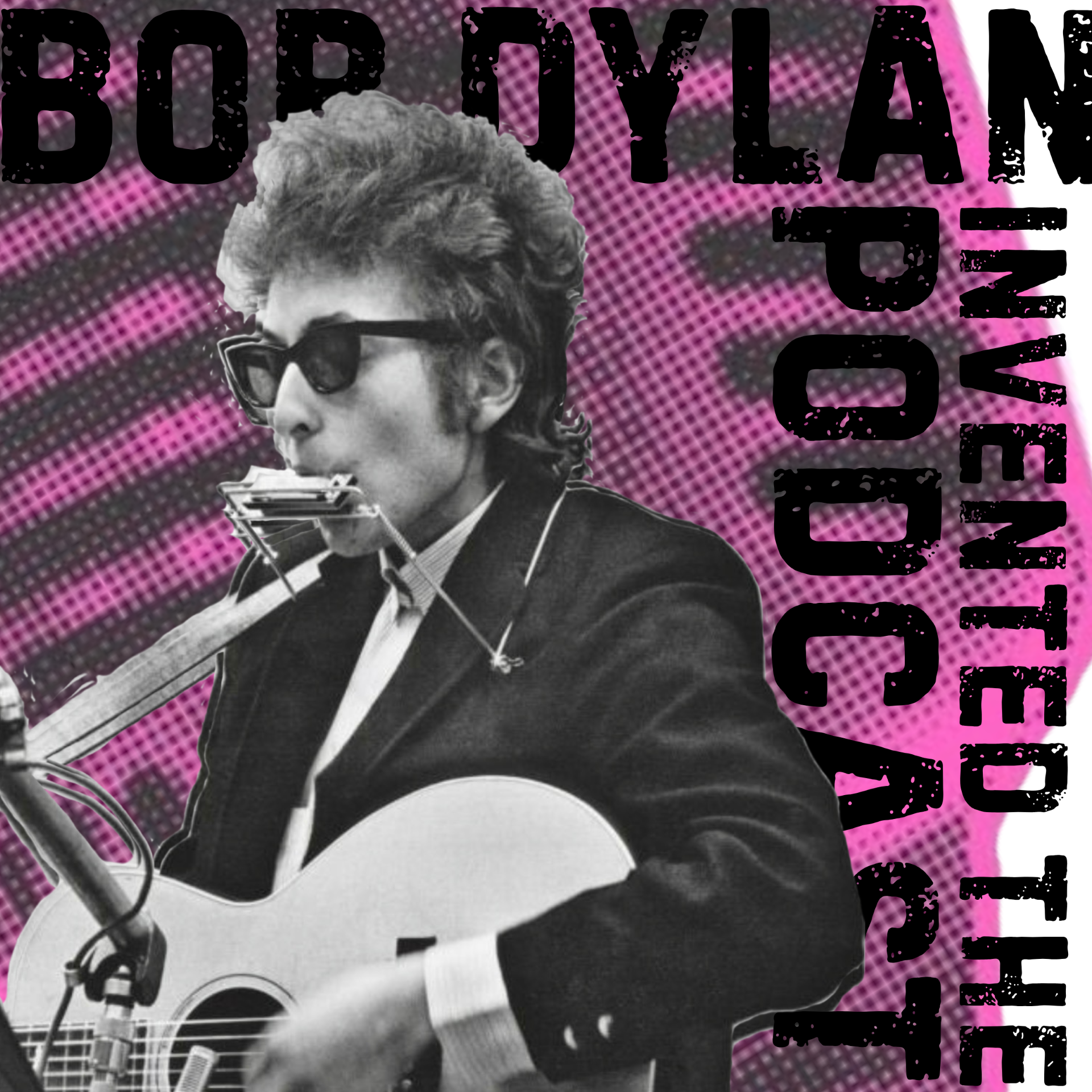
artwork by Alexa Robles.
As AI becomes frighteningly good at generating hyper-polished content, audiences are craving human imperfection—messy Instagram posts, analog media, grainy digital cameras, rambling conversation. In the modern world, podcasts thrive because they feel raw and authentic. Dylan established this appetite for raw intimacy in popular media long before the internet popularized it.
Podcasts are defined by something highly curated traditional media lacks: long form, unedited, candid conversation. Bob Dylan operates under the idea that “there would be no music without the words”, supposing that music is a container for story. Should the story take sixteen minutes and thirty one seconds to run its course, the music would need to accommodate. Dylan famously rejected the 3-minute-long formulaic pop songs of his era in place of storytelling—this demanded enough time to develop characters, historical narratives, complex allegories, and other literary techniques.
When the Nobel Prize in Literature was awarded to Dylan in 2016 “for having created new poetic expressions within the great American song tradition,” the committee had confirmed that music served merely as a vessel for Dylan’s writing. Dylan's subsequent lecture cited literary giants who served as his inspiration, then proceeded to close quoting one such figure, Homer: “Sing in me, o Muse, and through me tell the story”. In citing the father of oral tradition, Dylan placed himself in relation to ancient tradition, drawing from the human instinct to gather and listen to a voice tell a story. He prioritized the delivery of thought over musical polish, developing a voice that sounded less like a performer than it did a person sitting next to you at a bar. This level of intimacy and consciousness are at the core of the modern podcast.
“I'm in Boston town, in some restaurant
I got no idea what I want
Well, maybe I do but I'm just really not sure”
Is this a serial cold open? A Substack?
It's Bob Dylan’s song “Highlands”, a sixteen minute and thirty-one second stream of consciousness monologue. After recording it, producer Jim Dickinson asked ‘Well, Bob, have you got a short version of that song?’ Dylan replied: ‘That was the short version.’
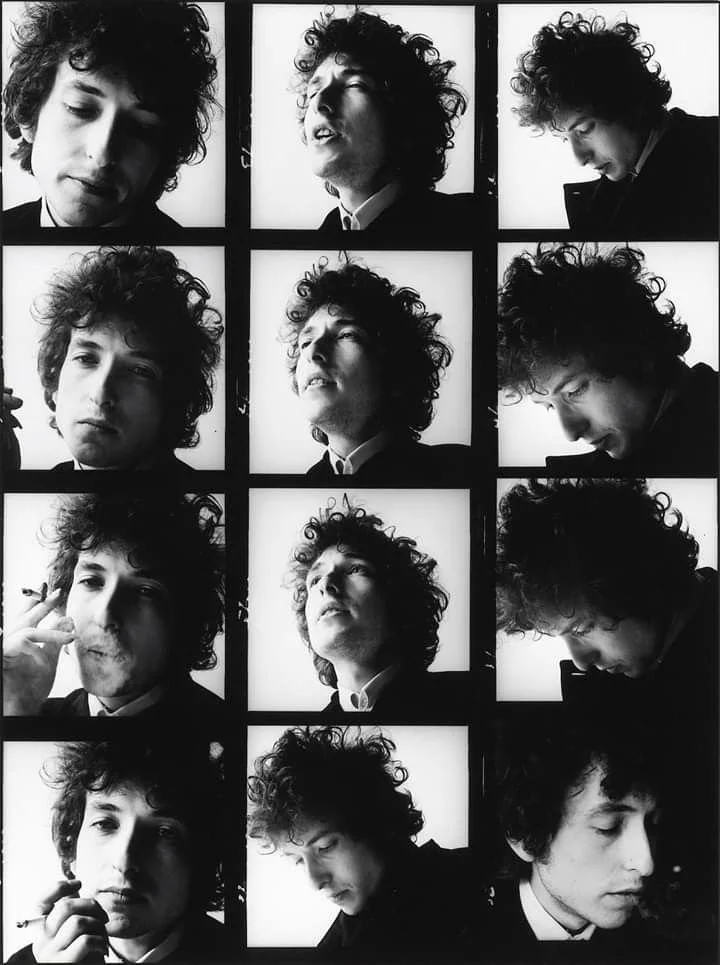
photo by Jerry Schatzberg.
Dylan treated songs less as high-production pop products than as a vehicle for argument and direct address. After emerging on the music scene in Greenwich Village in 1961, he spent three years writing two dozen politically charged songs reflecting the urgency of the civil rights and anti-war movements. “Masters of War” is a venomous attack on military leaders and government officials. He hisses “You hide in your mansion / While the young people's blood / Flows out of their bodies... All the money you made / Will never buy back your soul.”
Another one of Dylan’s potent protest songs, “Hurricane”, operates not as a broader philosophical condemnation, but rather unfolds as investigative journalism on the wrongful conviction of boxer Rubin “Hurricane” Carter. He sings, “How can the life of such a Man / Be in the palms of some fools’ hands? / To see him obviously framed / Couldn't help but make me feel ashamed / To live in a land where justice is a game.” Lingering on details, narrative expositions, accusations and fabricated testimonies goes far beyond the structure of a typical pop song. These lyrics demonstrate how Dylan treated song as a medium for complex storytelling and social commentary, proving that popular music can be just as intellectually deep as high literature.
Of course, Dylan wasn’t the first to write a protest song, but he paired that passion with the energy of the surf rock that dominated the Billboard Hot 100. Before Dylan broke through the charts in 1965, the Hot 100 list rarely featured social critiques, anti-war songs, and political commentary. When Dylan’s “Like a Rolling Stone” hit #2 in September 1965, “Do You Believe in Magic?” by the Lovin’ Spoonful and the Beach Boys’ iconic surf pop anthem “California Girls” were other top-10 tracks. While protest songs occasionally broke through (Barry McGuire's “Eve of Destruction” hit #1 that same year), Dylan brought a literary density the charts had never sustained. While Dylan wasn’t the first to lean into raw delivery, he did create a commercial appetite for it, a template that the current moment is starving for.
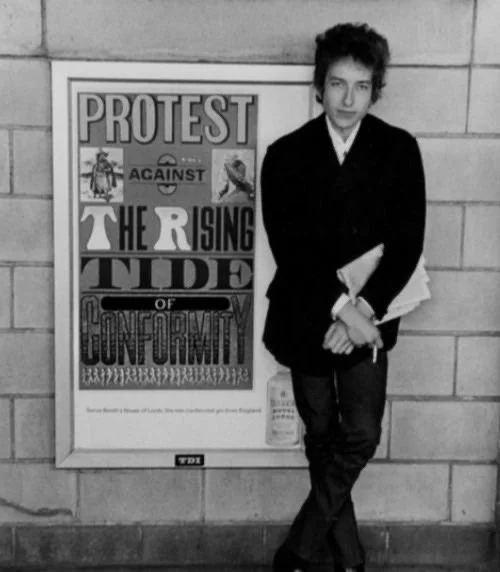
photo by Daniel Kramer.
Dylan’s unvarnished and natural sound was controversial in a decade of refined artists, and it remains so today. Critics recoiled at his scratchy, nasal voice and his conversational tone. Some of his fans even felt as if some political urgency had been lost in his excessively long ramblings.
That tension is exactly what makes him feel urgent right now. The music industry is pushing hard against the seamless synthetic production and perfect vocals of AI, and imperfection itself has become distinct, rare and emotionally valuable. Beyond aesthetics, AI lacks human thought and passion, and is incapable of impersonating the feelings that drive songs, like the angst and fury backing “Masters of War”. Dylan's rasp, digressions, unresolved thoughts, and fiery commentary all signal humanity, which feels rare, cherished and imperative today.
edited by Adam Hu.
artwork by Alexa Robles.
photos by Jerry Schatzberg and Daniel Kramer.